
January 3, 2026 - PBS News Weekend full episode
1/3/2026 | 26m 45sVideo has Closed Captions
January 3, 2026 - PBS News Weekend full episode
January 3, 2026 - PBS News Weekend full episode
Problems playing video? | Closed Captioning Feedback
Problems playing video? | Closed Captioning Feedback
Major corporate funding for the PBS News Hour is provided by BDO, BNSF, Consumer Cellular, American Cruise Lines, and Raymond James. Funding for the PBS NewsHour Weekend is provided by...
January 3, 2026 - PBS News Weekend full episode
1/3/2026 | 26m 45sVideo has Closed Captions
January 3, 2026 - PBS News Weekend full episode
Problems playing video? | Closed Captioning Feedback
How to Watch PBS News Hour
PBS News Hour is available to stream on pbs.org and the free PBS App, available on iPhone, Apple TV, Android TV, Android smartphones, Amazon Fire TV, Amazon Fire Tablet, Roku, Samsung Smart TV, and Vizio.
Providing Support for PBS.org
Learn Moreabout PBS online sponsorshipALI ROGIN: Tonight on PBS News Weekend, President Trump says the U.S.
will indefinitely run the country of Venezuela following the military's capture of Venezuelan President Nicolas Maduro.
Then, an on the ground report went Venezuela's capital, Caracas, as some celebrate the U.S.
operation but worry about what comes next.
And we head to one of the most remote parts of Alaska to see how the U.S.
Census Bureau is making sure government grants get to the people who need them the most.
MAN: These places are not on the road system most of the time.
You're flying in or boating in, and it's very prohibitively expensive to build.
With these grants, they're able to build more homes for people, build community centers.
(BREAK) ALI ROGIN: Good evening.
I'm Ali Rogin.
John Yang is away.
There are moments in time when history possibly pivots.
And today, in a stunning act of regime change, the U.S.
Military captured and brought Venezuelan President Nicolas Maduro to U.S.
soil.
Not long after that, in a remarkable declaration, President Trump announced the U.S.
would, quote, run Venezuela and warned of a new era of United States domination over Latin America.
We will get an on the ground report from Venezuela's capital, Caracas in a moment, but we begin our coverage with Nick Schifrin.
NICK SCHIFRIN (voice-over): It was just after midnight over Caracas when U.S.
helicopters with Delta Forces soldiers descended toward Nicolas Maduro's compound.
Nearby, residents filmed and cowered from U.S.
strikes on at least four locations.
All part of the mission to capture and extract Maduro.
By 2:00 local, they had him, and by 3:00 a.m.
he was shackled aboard the USS Iwo Jima, the dictator turned detainee of the U.S.
Department of Justice.
U.S.
military officials said U.S.
helicopters took fire as they left Venezuela but remained able to fly.
A source Familiar tells PBS NewsHour a small CIA team arrived in August and created extraordinary insight into Maduro's pattern of life that made grabbing him seamless.
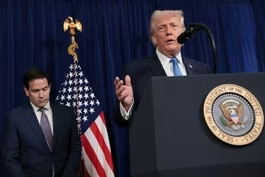
DONALD TRUMP, U.S.
President: This was one of the most stunning, effective and powerful displays of American military might and competence.
NICK SCHIFRIN (voice-over): In Palm beach today after he and his team watched the operation unfold overnight, President Trump announced the operation was not only about regime change.
DONALD TRUMP: We are going to run the country until such time as we can do a safe, proper and judicious transition.
NICK SCHIFRIN (voice-over): President Trump said Secretary of State Marco Rubio had spoken to Venezuelan Vice President Delcy Rodriguez, who was sworn in to replace Maduro.
DONALD TRUMP: She had a long conversation with Marco and she said we'll do whatever you need.
I think she was quite gracious, but she really doesn't have a choice.
NICK SCHIFRIN (voice-over): But at least publicly today, Rodriguez rejected that.
DELCY RODRIGUEZ, President, Venezuela (through translator): We demand the immediate release of President Nicolas Maduro and his wife, Celia Flores.
The only president of Venezuela is President Nicolas Maduro.
NICK SCHIFRIN (voice-over): And President Trump made clear part of the plan was to take Venezuela's oil.
The country has the world's largest oil reserves, which the U.S.
helped develop exactly one century ago.
But former leader Hugo Chavez kicked out some U.S.
and other foreign energy companies and today the industry produces a fraction of its capacity.
DONALD TRUMP: We're going to be replacing it and we're going to take a lot of money out so that we can take care of the country.
NICK SCHIFRIN (voice-over): But the president made clear today was not only about Venezuela.
This was about displaying an ability and willingness to enforce regional domination and embracing the early 19th century declaration by President Monroe to block foreign colonialism in the Americas.
DONALD TRUMP: They now call it the Donroe Doctrine.
I don't know.
Under our new national security strategy, American dominance in the Western Hemisphere will never be questioned again.
NICK SCHIFRIN (voice-over): Rubio made clear the next possible target.
MARCO RUBIO, Secretary of State: Yeah, look, if I lived in Havana and I was in the government, I'd be concerned.
NICK SCHIFRIN (voice-over): And to critics who question whether a president who was elected in part to avoid foreign entanglements.
MAN: Why is running a country in South America first?
DONALD TRUMP: Well, I think it is because we want to surround ourselves with good neighbors.
We want to surround ourselves with stability.
We want to surround ourself with energy.
We have tremendous energy in that country.
NICK SCHIFRIN (voice-over): Regime change not for democracy, but for energy and for its own sake, as the question tonight in Caracas and perhaps around the world.
Now what?
For the PBS NewsHour, I'm Nick Schifrin.
ALI ROGIN: Earlier this afternoon, I spoke to Feature Story News reporter Mary Triny Mena in Venezuela's capital, Caracas.
Thank you so much for joining us.
We are speaking a few hours before our show airs.
It's been an extraordinary day in Venezuela today.
What has it been like on the ground?
MARY TRINY MENA: Well, Venezuelans woke up hearing loud sounds.
Rumbling across the city was complex situations from early hours.
It began at 1:50 local time.
It lasted for about 45 minutes.
I hear.
I personally heard planes, airplanes and these detonations that kept happening for about 45 minutes.
It was a difficult situation, very complex with a low of information, a lack of information coming from the government of Nicolas Maduro.
Later on, they released a statement saying that this was an aggression perpetrated by the U.S.
and according to the Venezuelan government, the sole purpose of this kinetic strike was to gain control of Venezuelan oil resources.
This ended up with the destruction of the leader of Venezuela, Nicolas Maduro, and also his wife, Celia Flores.
Here in Caracas, there's been moments of quiet.
Most people have decided to remain at home considering the event -- today's events.
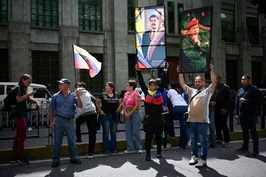
And also some people have decided to go to the streets, mostly the supporters of Nicolas Maduro.
We need to remember that the Maduro government were bracing for a situation like this for many months now.
And the former leader of Venezuela, Nicolas Maduro, told his supporters that in case he was not present, that people should go out to the streets while we are witnesses like small gatherings in Caracas mostly.
And the majority of Venezuelans remain at home waiting.
What is going to happen in the coming hours?
ALI ROGIN: We have about 45 seconds left.
President Trump today said that the U.S.
is going to be running Venezuela.
Is there any evidence on the ground that the United States is now in charge?
MARY TRINY MENA: No, there is no evidence so far.
The Venezuelan Vice President, Delcy Rodriguez appear on television saying that she is running the country that they are not happy with, of course, what happened and they will not surrender.
And they are calling this a kidnapping of the one and only legitimate president of Venezuela that they will keep continue running the country.
She appeared on television surrounded by members of the military forces and the main heads of the Maduro government, all lawyers to Nicolas Maduro.
ALI ROGIN: Mary Trina Mena with FSN, thank you so much.
MARY TRINY MENA: Thank you for having me.
ALI ROGIN: Now we turn to Jimmy Story, who spent 25 years in the U.S.
State Department and most recently served as the top U.S.
diplomat to Venezuela.
Ambassador, thank you so much for being with us.
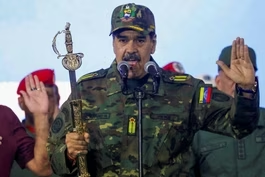
Clearly, the military achieved its mission here, but as you wrote today, tactical victories do not portend success.
In terms of the wider strategy, how do you think the strategy is playing out so far?
JIMMY STORY, Former U.S.
Ambassador to Venezuela: Well, the first question is what's the desired end state?
And is the desired end state is regime change?
Well, we don't have that.
What you have is a removal of the top of the regime where you cut the head off one part of the head of a hydra and you have the rest of the regime in power.
Very laudatory words about Delcy Rodriguez.
But at the end of the day, Delcy has been very adamant that what we did was kidnapped Nicolas Maduro.
So remains to be seen exactly what the end state we're seeking is.
ALI ROGIN: Yeah.
So what do you make of the fact that President Trump today said that Rodriguez was planning to work with the United States and then just a few hours later she said basically exactly the opposite?
JIMMY STORY: Well, it is curious.
I don't know if this is the case, the dog that didn't bark or the dog that barks too much, but at the end of the day we're going to.
What the president also said was that if we didn't have the right kind of support, there would be a second wave of attacks.
For me, there's a clear indicator here.
Are the wrongfully detained American citizens being released and are the political and military prisoners that are being held in the torture center called the helicoide, are they being released?
And if they're not, then this is just the same regime by different leadership.
ALI ROGIN: I'd like to play for you some sound from Democratic Senator Tim Kaine today who criticized this as did many other critics, saying that this was illegal and unwise.
Take a listen.
SEN.
TIM KAINE (D) Virginia: When the United States engages in unlawful attacks on other nations' sovereignty, it sends a message to the worst dictators in the world that they can do so as well.
And I don't want the United States to send the message that anything goes.
I want the United States to send a message that supports human rights and the rule of law.
ALI ROGIN: So, Ambassador, what message does this send?
JIMMY STORY: Well, I think Senator Kaine is exactly right on this.
I have a lot of respect for Senator Kaine.
This is a bad message.
I mean, what are the Chinese thinking right now about Taiwan?
And certainly if you look at the Russians, they invaded a sovereign nation, Ukraine, three years ago, over three years ago now in front of the entire world.
So we've lost the moral high ground on these issues.
For me, this was about democracy.
Maduro lost an election last year.
It was about human rights.
He is confronted with crimes against humanity, is about narcotics trafficking.
Of course, there's also about 9 million Venezuelans who have had to flee to seek a better life.
That's 25 percent of the population of that country.
It was about all those things.
Yet the president goes on TV today to say it's about oil.
So this is very disconcerting.
ALI ROGIN: I'd like to return to what you said earlier about the head of the hydra being cut off, but the rest of it remaining.
Certainly other ministers who were part of the Maduro regime are still intact.
The director of the internal security force, the director of the semi-official motorcycle gang is known as the Colectivos so really what do you make and can you expand on how much change this is ultimately going to lead to on the ground given that the rest of the Maduro regime remains intact?
JIMMY STORY: Well, I'm talking to people on the ground in Caracas and they would love to go out and celebrate the end of Maduro's dictatorial regime, yet they're fearful to do so because they know that d'Estada Corbello (ph) and Freddy Bernal and rest of these people who were specially designated nationals on the SDN list from treasury, they're sanctioned people, are liable to unleash these Colectivos, these motorcycle gangs, semi-official motorcycle gangs that are heavily armed to go out and intimidate them and potentially to begin a bloodbath.
So you're not going to see the kind of natural reaction to a really despised figure.
Maduro is a despised figure.
We can debate the legality all day long.
He lost an election.
He is not particularly well liked inside of Venezuela.
But the people of Venezuela are very nervous to do anything because the regime is still intact.
ALI ROGIN: Ambassador James Story, thank you so much for joining us.
JIMMY STORY: Thanks for having me.
ALI ROGIN: In today's other news, Iran's supreme leader vowed today to crack down on demonstrators following days of protests.
In his first public remarks since they began, Ayatollah Ali Khamenei said rioters must be put in their place.
Demonstrations will soon stretch into their second week as the country's currency.
The real plummets.
On Friday, President Trump warned Iran the U.S.
would come to the rescue of any peaceful protesters who face violence.
President Trump also weighed in on the war in Ukraine today, saying he's frustrated with Russian President Vladimir Putin.
He told reporters Putin is killing too many people.
That comes as European national security advisers convened in Kyiv to discuss the latest peace proposals.
The U.S.
is currently behind a diplomatic push to end the almost four-year old war.
Ukrainian President Volodymyr Zelenskyy is set to meet with European leaders next Tuesday in Paris.
Still to come on PBS News Weekend, why the city of San Francisco is suing the nation's top food manufacturers over ultra-processed foods and how the Census Bureau counts every last person, even in the most remote parts of the US.
(BREAK) ALI ROGIN: San Francisco is the kind of heavily Democratic city that the Trump administration often targets.
But there's one issue they agree on.
They're both taking aim at ultra-processed food.
In the first lawsuit of its kind, San Francisco is suing 11 of the nation's top food companies, saying they sell ultra-processed food knowing that they are harmful to health.
By some estimates, more than 60 percent of the food consumed in the United States is ultra-processed.
A growing body of scientific research says diet high in ultra-processed food lead to chronic diseases like obesity, type 2 diabetes, heart disease and depression.
Earlier, John Yang spoke with Ashley Gearhardt, a University of Michigan psychology professor who studies addiction.
JOHN YANG: Ashley, we just heard the San Francisco city attorney say that ultra-processed foods are designed to be addictive.
Do you agree?
ASHLEY GEARHARDT, University of Michigan: Yes.
In my lab that we see that these products can really trigger all the core signs of addiction.
That loss of control, those intense cravings, that continued use, even though you know it may be killing or harming you.
JOHN YANG: How do they do that?
What's, what are in the foods that make people addicted to it?
ASHLEY GEARHARDT: Yeah, there's a certain addiction playbook that's been used from tobacco to opiates to sports betting.
You take something that exists, typically exists in nature, like a plant or, you know, a fruit, and you alter it so it gives just this just right dose of reward.
It's stimulates you but doesn't fully satisfy you.
So you want to keep coming back for more.
You can titrate the smell, the flavor, the taste, and then you flood the environment with it.
So your consumers, even if they have a slight moment of temptation, the product is right at arm's reach and the next thing they know, they're using again.
This is what's happened to our food supply when Big Tobacco really took over in the 70s and 80s, and those same levers have been used to create ultra-processed foods that are now killing 1400Americans every day.
JOHN YANG: You say when Big Tobacco took over food, what do you mean by that?
ASHLEY GEARHARDT: In the 1960s, 70s and 80s, Philip Morris and R.J.
Reynolds started buying up the big food companies like Kraft and General Foods.
They created some of your favorite products and marketed them like Hawaiian Punch and Lunchables.
And there's evidence even from researchers like Laura Schmidt who has found that they have applied technologies, flavorants, marketing strategies that were honed to sell tobacco products and have applied them to the ultra-processed food holdings.
They divested some of these food companies in the mid 2000s.
But the stamp of Big Tobacco on our food supply has never changed.
It's actually just amplified over time and fundamentally changed.
JOHN YANG: The food that we eat, should it be regulated the way tobacco is now?
ASHLEY GEARHARDT: Yeah.
When I read things that the food industry is saying, you know, they're talking a lot about how to turn cravings into corporate profits.
Or they'll say, you know, indulgence has really been a main profit margin for us.
That's a big driver of how we're making money.
And so we've needed time and time again for the government to step in and put some guardrails on those sorts of companies so we and our children can live happy, sustainable, nourished lives rather than being in these cycles of just craving and crashing.
That doesn't benefit us, but does benefit those corporations.
JOHN YANG: Some critics say that the term ultra-processed food lacks a definition.
It's too broad that it scoops up a lot of products that may actually be healthy and excludes some that aren't.
What do you say to that?
ASHLEY GEARHARDT: The problem that's happening right now is when we just focus on specific nutrients like sugar or fiber, fat, the industry's been able to use that to do nutrient whack-a-mole.
They can pull so many different levers and distract us.
So we're eating ultra-processed junk that isn't nourishing us from, you know, low carb diet coke to, you know, low fat snack wells.
And we're forgetting what is real food and ultra-processed food by being.
This paradigm shift of really showing what that category is has really changed the name of the game and helped us work in a way that reflects the complexity of the industrial processes that we're now faced with.
JOHN YANG: You talk about the nutrients in food.
It used to be the diet research focused on the nutrients in food.
Is enough being done about how food is processed, how food is made?
ASHLEY GEARHARDT: Yeah, this is where the field is really moving.
I mean, we're realizing that ultra-processing is a pathway that you can simultaneously pull all of those levers of sugars and fats and salts.
But it's not just that the ultra-processing can speed up the absorption of those rewarding nutrients into the body in ways that your home cook can't.
One thing I've been learning a lot about recently is things like enzymatic processing that essentially resembles a little bit of the enzymes in your saliva or your digestive tract.
But that can be applied in food processing in a way that makes it more rapidly be absorbed into your system.
Grandma's homemade cookies were never delivering that sort of intensity.
We see that a lot with the flavor additives and the way that the industry can create just so many varieties.
I mean, the last time you've gone to the potato chip aisle, you know, there's dozens and dozens of these engineered flavors that are meant to burst into your mouth but then fade super rapidly.
So all of a sudden you finish that whole bag of potato chips.
This is uncharted territory.
And the technology has just advanced to such a stage that we need greater protections.
JOHN YANG: Ultra-processed foods are so ubiquitous, so pervasive.
Can anything really be done to curb this?
ASHLEY GEARHARDT: Yes.
I feel great optimism and hope.
And a large part of that reason is because the United States is an outlier where the majority of our food is now ultra-processed.
Countries like Italy and Greece, they don't have this.
Less than 20 percent of their food supply is ultra-processed.
We created this problem by what we've invested in, what our governments put its money in, what we've incentivized companies to do.
We absolutely have the levers to start to invest in real food that's convenient, affordable and tasty, just like other countries get, so we can be strong and healthy and happy going into the future.
JOHN YANG: Ashley Gearhardt of the University of Michigan, thank you very much.
ASHLEY GEARHARDT: My pleasure.
Thank you so much for chatting with me.
ALI ROGIN: Finally tonight, the next major U.S.
national census is in 2030.
But this year, the Census Bureau will be conducting field tests to try to come up with better ways to count the most hard to reach populations.
Places like remote Alaska, where during the last census, officials came up with an innovative plan to count one of the most remote villages in that state.
Here's Matt Faubion from PBS Alaska.
MATT FAUBION (voice-over): Alaska is known as the last frontier for his harsh winters and vast, remote landscapes.
But for more than 150 years it has also been by tradition the first place Americans are counted in the American census.
In 2020 it began in a small town of Nunakauyaq known as English Toksook Bay located along the state's southwest coast by the Bering Sea.
That year the U.S.
Census counted just 672 people, most of them Alaskan natives, members of the Yupik people, including James Sippary, whose family has lived in this area for generations.
JAMES SIPPARY, Elder, Toksook Bay: This village used to be a fishing camp and my grandfather's camp winter and summer for the survival of his families.
MATT FAUBION (voice-over): Today, survival for many in Toksook Bay depends on federal and state funding.
MAN: Get the rest of the stuff.
MATT FAUBION (voice-over): Vital resources that help cover the cost of housing, health clinics, and supplies for the only school here.
But as state demographer David Howell explains, in order to fairly dole out these funds, an accurate census is a must.
And in remote Alaska, that's no simple task.
DAVID HOWELL, Alaska Department of Labor: These places are not on the road system.
Most of the time you're flying in or boating in.
Rivers become highways for snow machines.
MATT FAUBION (voice-over): So during the last census, in addition to the traditional door to door outreach, they tried something else.
For the first time.
They gave residents the option to submit information by mail or online instead.
WOMAN: All census responses are completely confidential.
MATT FAUBION (voice-over): But their efforts to solve one problem quickly created another.
Residents voiced concerns about sharing sensitive personal data.
They worried their information could be intercepted in the mail or hacked online and their identities stolen.
It turns out those concerns were not unfounded.
The state had simulated an attack on resident census data years earlier.
DAVID HOWELL: A scenario in which if this data was stolen from the bureau, how many records could you match to the actual population?
And so they were able to match quite a high number.
MATT FAUBION (voice-over): The U.S.
census came up with a plan to address the residents of Nunakauyaq's concerns.
They embraced a cutting edge mathematical algorithm called differential privacy.
It compiles the big picture data statistics of a group while protecting specific private information of each individual.
It's kind of like if we took a high resolution picture of this Yupik dance group.
We can see facial features that could expose people's identities.
The algorithm adds digital noise to blur a few faces slightly or adds static to the overall photo.
And the quality is lowered just enough to protect everyone's identities.
The Census Bureau applied that photo altering principle to Toksook Bay in 2020.
They say it helped ease residents' fears and protected their identities.
It also produced an accurate count which made sure needed funding got to the right places.
DAVID HOWELL: And it's very prohibitively expensive to build.
With these grants they're able to build more homes for people, build community centers.
Just all sorts of projects are grant funded.
If your population is off, you may not get approved for such a thing.
MATT FAUBION (voice-over): Elder James Sippary is excited about how accurate census data can help tackle the desperate of his community.
JAMES SIPPARY: The very important things that I would like to see is the native workforce development.
Prepare our people for their future as we journey on forward to win for life.
MATT FAUBION (voice-over): As the census prepares for the next count in 2030, residents in Alaska's most remote places like Toksook Bay know they will be counted and their individual privacy will not be compromised.
For PBS News Weekend, Matt Faubion in Toksook Bay, Alaska.
ALI ROGIN: And an update today's top story, the plane carrying Venezuelan President Nicolas Maduro and his wife has landed in New York City.
And that's our program for tonight.
I'm Ali Rogin.
For all of my colleagues, thank you for joining us.
See you tomorrow.

Census officials work to count every person in remote Alaska
Video has Closed Captions
Clip: 1/3/2026 | 4m 12s | Census officials work to count every person in Alaska’s most remote places (4m 12s)
Former U.S. ambassador analyzes goal of Maduro regime change
Video has Closed Captions
Clip: 1/3/2026 | 4m 23s | Former U.S. ambassador to Venezuela analyzes goal of Maduro regime change (4m 23s)

News Wrap: Iran vows crackdown on ‘rioters’ amid protests
Video has Closed Captions
Clip: 1/3/2026 | 1m 26s | News Wrap: Iran vows crackdown on ‘rioters’ amid protests over economy (1m 26s)

San Francisco sues food companies over ultra-processed foods
Video has Closed Captions
Clip: 1/3/2026 | 6m 45s | Why San Francisco is suing top U.S. food manufacturers over ultra-processed foods (6m 45s)
U.S. military captures Venezuela’s Maduro in surprise strike
Video has Closed Captions
Clip: 1/3/2026 | 4m 3s | Trump says U.S. will ‘run’ Venezuela after capturing Maduro in surprise military strike (4m 3s)
Venezuelans react to Maduro’s capture by U.S. forces
Video has Closed Captions
Clip: 1/3/2026 | 3m 5s | How Venezuelans in Caracas are reacting to Maduro’s capture by U.S. forces (3m 5s)
Providing Support for PBS.org
Learn Moreabout PBS online sponsorship
- News and Public Affairs

FRONTLINE is investigative journalism that questions, explains and changes our world.

- News and Public Affairs

BREAKING the DEADLOCK sparks bold, civil debate on America’s toughest issues.












Support for PBS provided by:
Major corporate funding for the PBS News Hour is provided by BDO, BNSF, Consumer Cellular, American Cruise Lines, and Raymond James. Funding for the PBS NewsHour Weekend is provided by...