Here and Now
US Rep. Scott Fitzgerald on De-escalation and Funds for ICE
Clip: Season 2400 Episode 2431 | 9m 42sVideo has Closed Captions
Scott Fitzgerald on law enforcement de-escalation and the Department of Homeland Security.
U.S. Rep. Scott Fitzgerald, R-5th Congressional District, discusses debate in Congress over de-escalation practices by law enforcement officers and funding for the Department of Homeland Security.
Problems playing video? | Closed Captioning Feedback
Problems playing video? | Closed Captioning Feedback
Here and Now is a local public television program presented by PBS Wisconsin
Here and Now
US Rep. Scott Fitzgerald on De-escalation and Funds for ICE
Clip: Season 2400 Episode 2431 | 9m 42sVideo has Closed Captions
U.S. Rep. Scott Fitzgerald, R-5th Congressional District, discusses debate in Congress over de-escalation practices by law enforcement officers and funding for the Department of Homeland Security.
Problems playing video? | Closed Captioning Feedback
How to Watch Here and Now
Here and Now is available to stream on pbs.org and the free PBS App, available on iPhone, Apple TV, Android TV, Android smartphones, Amazon Fire TV, Amazon Fire Tablet, Roku, Samsung Smart TV, and Vizio.
Providing Support for PBS.org
Learn Moreabout PBS online sponsorship>> The ICE surge is ending in Minnesota.
White House borders are Tom Homan announcing the move as U.S.
Senate Democrats vote to block funding for homeland security over demands for stricter rules of engagement for immigration agents.
Also this week, the House passes new election rules aimed at preventing noncitizens from voting.
Tonight, we're joined by Republican U.S.
Representative Scott Fitzgerald from Wisconsin's fifth congressional district.
And Congressman, thanks very much for being here.
>> Good to be with you.
>> So a busy week, as always in Washington.
What's your reaction to the immigration enforcement surge ending in Minnesota?
>> I mean, I think the president handled it very well.
Tom Homan has become a figure that, quite honestly, is very well trusted by both sides of the aisle.
If you go back even to the Obama administration, the president had a relationship with Tom Homan.
And and ever since then, he has been obviously a figure that's high profile.
But I think what the president did there made a lot of sense.
De-escalate, bring down the temperature.
Let's let's figure out how to do a better job of this.
And so far it's it seemed to have worked well.
>> So how would you grade the overall operation making mention here?
Of course.
Of the two U.S.
citizens killed by agents in the midst of it?
>> Yeah, both obviously very unfortunate incidents.
I think it did show that the idea that if you were going to go into any community in the United States and you were going to receive resistance from local law enforcement, or if there was going to be kind of this this situation where Ice was not really operating under the idea that they were going to be able to go in and apprehend people using some type of detain order, then what you would end up with is this back and forth in the streets.
And and certainly that wasn't productive.
So, you know, unfortunately the border was open for four years under the Biden administration.
And one of the things that President Trump ran on was that he was going to apprehend those that had criminal records and and deport them.
And, you know, but how that was going to be accomplished is as varied from state to state.
>> Do you feel as though law enforcement should be better at de-escalating a special, especially after seeing what happened in Minnesota?
>> Well, I think we're in uncharted waters, right?
I mean, this is not something that the average law enforcement agency has really dealt with in the past.
If if there was not such a high number of illegals and those with criminal records, it's very easy for them to simply go to any county jail where they've already been apprehended.
And there would just be a turnover to to Ice.
And other than in some sanctuary cities, that is the way it's always happened.
Now there's a much higher number of illegals in the states right now than we've ever seen before.
But, you know, that process has always served us well, but we find ourselves in in a different position right now.
>> Meanwhile, the stopgap funding for Homeland Security expires at midnight.
What's your response to Democrats demands for new rules for Ice and other agents, including not wearing masks and requiring the use of judicial warrants?
>> Yeah, I mean, I think if you look at the laundry list of things that Senator Chuck Schumer had rolled out from the Senate, it was kind of dead on arrival in the House.
So there would have had to have been some other type of negotiation.
And and it appears that the white House did kind of make a run at it, that they were trying to pull together a list that might have been acceptable, but the ten or so items that that the Senate had laid out was not going to happen.
So we find ourselves in a unbelievable situation.
I think, of the Democrats kind of holding this up again, and a very small government shutdown related to homeland security, which makes no sense because Ice is funded.
It was funded in the one big beautiful bill.
There's still excess dollars there.
Homeland security says they can operate for months with with Ice being able to still accomplish their jobs.
But yet you're shutting down things like the Secret Service and you're shutting down TSA at the airports, and you're shutting down the Coast Guard operations.
So there's all these other provisions and parts of of Homeland Security that are going to be left unfunded.
And, and they all run out of money at different times.
So it's this really is the the most political move we've seen so far, I think from, from the Senate Democrats.
>> Would you like to see a surge of immigration enforcement in Wisconsin?
>> I've been asked that question specifically about like the city of Milwaukee.
I don't I don't think it's been necessary.
I know some people disagree with that, but we just don't see the numbers that we've seen kind of in some of these other areas.
But I know Madison is a sanctuary city there.
There doesn't seem to be the level of of certainly, I guess, animosity between local levels of government and, and Ice being able to do their job.
So it just doesn't appear to me that, that we would be at the top of the list where where maybe those Ice agents may, may end up.
So it's it's kind of, I guess a wait and see, but but doesn't, doesn't appear to be the a good a good thing for Wisconsin and I think maybe not necessary for Ice.
>> On elections legislation ahead of the midterms.
New requirements would require proof of citizenship to register and vote.
Now, Democrats, of course, say this is voter suppression and solution in search of a problem, because non-citizen voting is a small number.
What about that?
>> I mean, I've been through this as majority leader of the Wisconsin State Senate.
I've now been through it through numerous bills in the House of Representatives.
Listen, at the end of the day, 85% of Americans think that you should have to present some form of ID when you go vote.
It's bipartisan support.
The the response from the other side of the aisle has been, I think, almost laughable in that they continue to just pretend like that, that type of poll number or support for voter ID doesn't exist.
>> This is.
>> There's no other reason to support it other than people are not presenting their their IDs at the polls.
>> Congressman, this is something more than that though, right?
It's a passport or a birth certificate to register to vote, which is a higher bar than just a photo ID.
>> Yeah, I mean, there's there's a lot of criticism from the other side of the aisle.
I mean, you can nitpick any of these bills by saying that you're asking for more information other than a driver's license.
But in most states, I mean, the documents that you need to provide to get that driver's license, unless there's a full out kind of anybody who shows up, gets that, gets that initial document, they fill it out and they're granted a driver's license.
It is still some form of ID and I, and I'm not saying that, you know, the bill, the save act, which which I think is well done and has been crafted correctly, I, you know, I've never been a big supporter of just federalizing these election laws.
I think it's important to keep some of these things decentralized.
So for me, somebody that served in the state legislature for so long, I mean, there is part of this discussion in which I'm saying, listen, this is what American people need to believe in the election cycle, especially in Wisconsin, where I run into constituents all the time that still think that the 2020 election was manipulated by rules related to Covid.
It happens all the time.
I run into people all the time that talk to me about that.
This would instill some what I what I think some concrete evidence that people that show up at the polls have some type of document in their hand, some type of, of driver's license in their hand to prove that they're a citizen and prove that they're a wisconsinite and they should be voting in that election.
>> Congressman Scott

Wisconsin's Tribal Nations Assert Reciprocity and Resiliency
Video has Closed Captions
Clip: S2400 Ep2431 | 5m 39s | Chairwoman Nicole Boyd delivers the 2026 State of the Tribes Address. (5m 39s)
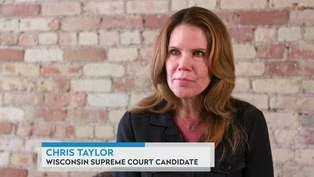
Chris Taylor on the 2026 Wisconsin Supreme Court Race
Video has Closed Captions
Clip: S2400 Ep2431 | 9m 44s | Chris Taylor on her perspectives on the law and the politics of judicial elections. (9m 44s)
Providing Support for PBS.org
Learn Moreabout PBS online sponsorship
- News and Public Affairs

Top journalists deliver compelling original analysis of the hour's headlines.

- News and Public Affairs

FRONTLINE is investigative journalism that questions, explains and changes our world.












Support for PBS provided by:
Here and Now is a local public television program presented by PBS Wisconsin