Donnybrook
Donnybrook | July 23, 2026
Season 2026 Episode 30 | 27m 56sVideo has Closed Captions
Alvin Reid debates with Sarah Fenske, Joe Holleman, Wendy Wiese, and Bill McClellan.
Alvin Reid debates with Sarah Fenske, Joe Holleman, Wendy Wiese, and Bill McClellan.
Problems playing video? | Closed Captioning Feedback
Problems playing video? | Closed Captioning Feedback
Donnybrook is a local public television program presented by Nine PBS
Support for Donnybrook is provided by the Betsy & Thomas O. Patterson Foundation and Design Aire Heating and Cooling.
Donnybrook
Donnybrook | July 23, 2026
Season 2026 Episode 30 | 27m 56sVideo has Closed Captions
Alvin Reid debates with Sarah Fenske, Joe Holleman, Wendy Wiese, and Bill McClellan.
Problems playing video? | Closed Captioning Feedback
Where to Watch Donnybrook
Donnybrook is available to stream on pbs.org and the PBS app.
Donnybrook Podcast
Donnybrook is now available as a podcast on major podcast networks including iTunes, Spotify, Google Play, and TuneIn. Search for "Donnybrook" using your favorite podcast app!Providing Support for PBS.org
Learn Moreabout PBS online sponsorshipSupport for Donnybrook is provided in part by Design Aire Heating and Cooling.
Donnybrook is made possible by the support of the Betsy and Thomas Patterson Foundation and the members of Nine PBS.
Hey there, Alvin Reid with you for one more week.
Charlie will be back next week.
And we've got a task force of five here to settle all of St.
Louis' problems.
Welcome aboard to Donnybrook.
With me tonight, media veteran Wendy Weise.
The birthday boy, Bill McClellan.
Happy birthday, dude.
From St.
Louis Magazine, Sarah Fenske.
And from the St.
Louis Post-Dispatch, Joe Holleman.
Well, Election Day is getting here pretty quickly, less than two weeks away.
And really two of the main topics are Amendment 4 and Amendment 5.
One, 5 would deal with the Constitution and how we could, the petitions, how we can change parts of the Constitution.
And Amendment 4 is dropping the personal income tax.
A lot of debate back and forth, but the day is here.
How are you feeling on both of those?
Boy, I don't know if either of these are going to succeed.
I think this Amendment 5 maybe has a better chance than Amendment 4, the one that deals with this personal income tax.
I feel like there's a lot of people who are saying, what is the plan here?
Like, I'm not necessarily against shifting taxes, but it seems like they're planning to take away some taxes and they don't really have a plan to tell me what they're going to tax instead.
You know, today, right before we got to this table, the Catholic bishops all came out against it.
I feel like that feels somewhat unusual that they're wading into tax policy.
But they're saying this would be so regressive, it would hit poor people so hard and give a nice tax break to wealthy people.
I don't know.
I think that could persuade some people as well.
I think the indefinite, that window, that five year window where legislators in Jefferson City are going to be, you know, sort of running the table and deciding what's going to move there.
You know, it's going to move.
There's not enough concrete areas of this for people.
So I think that might be part of the problem.
I'm not giving unreserved support for this.
I will say this.
I think it's a move in the right direction.
I like the idea of cutting taxes.
Now, whether or not this is the perfect vehicle for that, they're going to decide, you know, come August 4th.
But the idea of let's quit taking so much money away from the people who are earning the money.
I think what everybody leaves out is, is that that's the first step.
The second step is quit spending so much.
Because what happens here is everybody says, well, you're going to take away and let's just say $10 million.
But last year we spent $80 million.
What do we do?
Spend less.
That's the part nobody wants to talk about.
Republicans or Democrats.
They both sides love spending money.
They just love spending money on different things.
And I think what has to happen is, is let's lower taxes.
And by the way, Republicans and Democrats quit spending so much.
So without that, no tax decrease works if you're not going to decrease spending.
Well, I'm going to disagree, Joe.
I think if anything we need to spend more money.
It's just like in the city.
We all know, you and I agree, we need to pay the cops more.
We need to get more cops.
And we need the federal government to kick in for FEMA.
We need all these things.
And the idea that we're going to cut taxes and have less money to spend on projects, I just don't think that works.
And I hear what you're saying.
And it must be spent on this.
The problem is, is government looks at every bit of spending as we must spend this.
And honestly, I believe there's a whole lot of money that government spends that's wasted money.
And I think there needs to be a sharper focus given to what stuff are we doing that we could just quit doing and put it toward FEMA and police officers and things that are necessary.
I want to do this waste and fraud argument.
I've heard it so much that we're going to cut taxes and say, well, how are we going to support the government then?
Waste and fraud.
And no one's been able to come up with the waste and fraud solution.
Because no one wants to find it.
I think everybody would like to find waste and fraud.
But when we talked about waste and fraud back in the salad days, you know, of the 80s and 90s and 70s and even the early 2000s, that's one thing.
But if you're just pushing money down this black hole where everything seems to be so uncertain at this point, the future of downtown, we've got data centers, we have crime, we have school problems that are more of an issue now, I think, in the post-COVID world than they were before.
And it kind of feels like the messaging on this has been so muddy.
Like, I don't even hear anyone saying what you're saying.
Like, oh, yeah, we're actually going to have, like, a net cut to, like, the revenue coming into the state.
They're saying, no, we're going to change where it's coming from and all the programs will still stay.
Don't worry about that.
But it turns out we might start taxing the heck out of all these services.
And it's like, what kind of argument is this?
On that part, I agree with you.
And it is a clear case of politicians wanting their cake and eating it, too.
So, yeah.
All right.
You mentioned data centers, Wendy.
But, Bill, I'm going to start with you.
I guess it's called a compromise.
I call it capitulation.
All of a sudden, all of the, you know, green regulations for data centers that would be coming to the city of St.
Louis have been waived mysteriously.
Like I said, this, I just don't get it.
I mean, I'd say I think if they want to build it, make them pay and make them do it the way that you say to do it.
But apparently the city and its aldermen feel differently.
Well, you know, it's the old money talks.
And that's what seems to have happened here in this idea that, well, you know, we're going to keep these strict rules.
But you can get a waiver.
I mean, and Alderman Olinburg said, and expect strict scrutiny.
You know, there will be no strict scrutiny.
I mean, you know, it's the old thing.
It's better to, what is it, ask forgiveness rather than permission.
I mean, when these data centers all of a sudden they can't get, they can't follow these green regulations.
So they want a waiver.
I mean, the city is not going to say we're not going to give you the waiver.
And suddenly instead of an AT&T wasteland, we now have all this field of the data centers because we've shut them down.
Once they're built, they're built.
Yeah, I think there's some really heavy pressure that came to bear at City Hall.
You know, there are a lot of moneyed interest going right now into this idea that we need to build so many data centers right now.
And I think the city said we have some really sort of common sense regulations.
We want to find a way to still have data centers, but not have the hugest ones, not have them everywhere.
Make sure they're doing it green.
And basically the moneyed interest said this is a de facto ban.
Like these, we cannot possibly build under these regulations.
And so now what they're painting is a compromise.
It's the compromise to what was portrayed as the compromise.
It feels like they're getting what they want.
Money talks at City Hall.
It's like a boutique data center.
You know, it's like, it's kind of like Goldilocks.
It's too big, too small, just right, that kind of thing.
And when Megan Greene signs off on it.
Well, because at the end of the day, you come up with all these great things you want, and then the people with the money go, we're not going to do it.
We'll see you.
We'll find somewhere else.
And they go, no, wait a minute.
Wait a minute.
So we know what it's about.
It's about money.
And the city wants the money.
So there you go.
Do you feel as though they shouldn't have even went down this path in the first place if they were just going to just say, like, all right.
No regulation.
Why bother?
I think, you know, they are trying to clean up their zoning code.
There is this massive project underway called the ZOOP where they're trying to say, we don't want this to just come down to getting a waiver.
It shouldn't be about who you know and having to go before obscure boards.
There should be, like, clear-cut zoning.
So they had to deal with the data center issue as part of this.
But what that looks like, I think, has gotten sort of messed up.
Their intentions were good.
I do think so.
I do, too.
Like I said, I think they folded.
Alvin does not.
They did fold.
I also think if you're going to capitulate, it's best to fight hard first and then capitulate.
All right.
Okay.
And they folded in sort of a friendly way.
Kind of a neighborly way.
That is true.
It was an envelope, not a fold.
I don't think critics of data centers are going to be happy to know that this was all kumbaya.
Exactly.
You're right.
Speaking of kumbayas, all right, Regional Business Council, powerful organization.
Many of the leading businesses in the region have come out and said, we want the city to merge back into the county.
I guess what ended at the great divorce years and years and years ago.
Wendy, we are county dwellers.
We outvote the city ones, three-two here today.
But what's going on with this merger talk?
It seems like it's, like, at least for real this time.
I think, as Sarah said, there are people who have a great deal invested in our future.
And they want this door to be open again.
What I thought was kind of interesting, so the RBC, you have 100 CEOs.
And they have been having secret meetings.
They've learned about the history of the great divorce back in the 19th century, which I thought was kind of interesting that they looked at the history involved.
But they seem to be saying that, unlike Better Together, the municipalities get to keep their identities, which I think is sort of self -defeating.
I mean, I'm open to anything, truly, because I do think we should be unified.
But still having the 88 or 89 municipalities seems like that would be counterproductive.
But they do seem to be focusing on redundancy, where you've got too many overlapping situations and absolutely no one orchestrating.
And I think we're all in favor of that kind of thing, because I think it's also counterproductive.
Looks like Chicago being part of Cook County.
Right, right.
I mean, it's the way most of the world operates.
One of the things I don't like about it is I believe in the two-party system, which the county barely has.
It's so Democratic.
The city doesn't have it at all.
And if the city becomes part of the county, then it's all Democratic.
And even though I'm a Democrat, I think it's nice to have Republicans elected now.
I don't know.
I understand that you're adding more Democratic votes, I think, but also I think it emboldens those municipalities where there are a sizable number of Republicans.
I think it gives them a chance maybe to say, like, here's our chance, maybe.
I'm just saying.
Enough people would say, like, you know what?
The city's part of us now.
So let's vote in a way.
I don't want to say that the city doesn't like, but let's try to help the city bring some order out of the chaos.
It will certainly more, I think, more than being the end of Republicans having a lot of power, I think they'll continue to hold sway in big swaths of this county that now has the city a part of it.
It will be the end of progressives having a lot of power because they were able to seize control of the city where, you know, turnout is pretty minimal.
Democratic Party, one-party rule for a long time.
The separate wings sort of split off.
I think that'll change.
I don't think it's coincidental that the Regional Business Council is pushing this.
I think they'd like to quash that one.
Well, and I also think it's fading out on its own.
There's a whole sector.
But I do think this is so much more palatable to city voters.
We did not want to be part of this UNIGOV where we had to answer to Steve Stenger and like all power was diluted.
Being able to continue to be our own municipality, getting to elect our own mayor, I think it's a good, reasonable step.
Like, we can get rid of having our own recorder of deeds and share a recorder of deeds with y'all in the county and we will survive.
And I think another aspect of it, too, and it's sort of sad, is that, you know, at one time the city was the big dog on the block and we didn't want to be part of that, you know, country bumpkin county.
Then county was where all the money was at and the city was struggling.
Now we're all struggling.
Yeah.
That's a good point.
We each want to marry the other for the money.
That's right.
Neither one of us have a lot.
Right.
It's sort of the looks.
We get married and find out we're still all broke.
That's right.
Now we're both broke.
But we're less broke together.
Right.
Less broke together.
Less broke together.
Oh, I love that.
I love that.
The city might be a little bit broker.
But, yeah, I'm with you on that 100%.
And I will say I think the city is actually less broke.
We have a large surplus right now which is not true of y'all and it's not true of St.
Louis County as a whole and it's not true of Kirkwood.
Alvin?
Well, hey, first of all, the city is now under Kirkwood.
They're looking for $15 million.
And you make an excellent point.
Right.
You know, like, Kirkwoodians can't talk right now.
Right.
We'll get out of our hole a lot faster than the county does and we'll see what the city does with their surplus because they sit around on their money until it's money.
Right.
So speaking of changing things, the Kresge Foundation representatives were in St.
Louis and went over, like, Detroit and St.
Louis.
Now, years ago, I said Detroit's got it going on because Mayor Bing at the time said, like, hey, you know what, we need to bulldoze, like, and flatten out parts of this.
And he actually did.
It kind of cost him politically.
But Detroit kind of began their, I won't call it a renaissance, but at the same time doing much better.
And like I say, the reps were here and said, like, hey, you could be like Detroit, St.
Louis.
So, Bill, you think we could pull off that miracle, too?
Well, the big push behind the Detroit miracle, as I understand, was Dan Gilbert of Quicken Loans, now Rocket Mortgage, who bought millions of dollars worth of downtown real estate and then brought in his entire workforce, thousands of workers downtown.
And that gave new life to downtown Detroit.
And we don't have a guy like that.
I mean, you know, we have the Taylors and they built a soccer stadium.
But even if they said we're going to bring Enterprise headquarters down, it's not enough.
So I hope we can do it.
But I think without a Dan Gilbert, it's difficult.
Also, you mentioned very briefly, and I just expound on that a bit, if anything is going to work, when I was in Detroit in 2006, we have to be willing to just bulldoze stretches of property, because that's what they did.
And their basic case was, is if you want to develop something, it's much more attractive if there's nothing there, as opposed to having to go in, tear down the structures that are there, and then you're going to build an office building or you're going to build some homes.
They just leveled it.
I remember driving from Grosse Pointe into Detroit.
And it just looked like the scene you saw in Europe in the war.
It was like down to the ground.
I mean, just for mile after mile after mile of it.
So there's a lot of things, you know, if you want to do those sort of things, then you have to do bold things.
And what happens when we start talking in St.
Louis is we go, you can't tear that down.
You can't tear this down.
Well, something's got to go.
My grandparents were married there.
And I get all that feeling.
But I mean, there were just miles and miles of vacant ground.
But so we would have to bulldoze around the data centers, is what you're saying.
We would get a waiver.
We would get a waiver.
A bulldozer waiver.
I think a destruction waiver.
I was there in 2010, believe it or not, covering a boxing event at the Silverdome, and it stretched from Pontiac in places back to Detroit.
And when you saw it, no matter what your thoughts were on it, when you saw it, you said, like, you could work with this.
And I know it's a perplexing dilemma here in St.
Louis, but.
Didn't they have, like, farm stands in downtown Detroit?
I mean, where they were, some people actually, like, were planting crops on some of these city blocks.
I remember that.
It was just.
You could have.
Yeah, you could have.
I mean, I think the thing that happened in Detroit is they hit rock bottom so hard.
And, you know, that bankruptcy.
And they were bankrupt.
Massive.
Right.
So they were like, okay, we have to make some really difficult choices here.
I think part of what has been complicated in St.
Louis is we have not hit that hard.
There's still so much of life here that is so livable and so good that you're able to say, okay, well, you know, we don't want to be the person who bulldozes Mill Creek, and we look back on this as, like, wow, we cleared out this area that was cool, and we turned it into a wasteland.
Like, we don't want to make that same mistake again.
And so, you know, I read a lot about what was said at this Detroit thing yesterday.
There was a lot to chew on.
I'm glad they came.
But I don't know that I came out of it with, like, a super clear direction of what makes sense for us right here.
I hear you.
And Bill makes a good point that, obviously, it would take some billionaire backing.
Yes.
And I think together we do have it.
We don't have maybe one individual, but we have individuals in St.
Louis that could make this work.
Bob Clark.
If they really wanted to make this work.
And I don't think they've made the decision yet to make this work.
And the funny thing is, if the city merged back into the county, all of a sudden they might think, hey, this could work.
Well, AB InBev, you know, they were our highest profile corporate citizen.
And do they ever, like, stick their head out of the, you know, the beer magic factory?
Oh, the 150th party for Budweiser, which was huge.
That was pretty cool.
It's things like that.
But I'm talking about... They don't get involved politically.
And that's unfortunate, because this is part of their... Well, they're Belgians now.
Right.
I know.
But this is part of their future, too.
Well, and they're still selling beer, though.
I mean, their future seems pretty good.
They're doing fine.
And they are employing thousands of St.
Louisians.
You know, and that's the thing.
It comes down, people love beating up on big corporations.
They employ thousands of people.
McDonald or Boeing, you know, people.
You can complain about them, and they're legitimate gripes at times.
They also give thousands of people paychecks, who then go buy the homes and go to all these bars we want to develop.
Right.
I'm not hating on them.
Not at all.
All right.
In Normandy, they would like to establish a task force to look at that school district and its shortcomings.
And also, really, in general, how do we fix broken schools and broken school districts?
Going back just for a second to the city-county merger, one thing that I kind of think is that the region is kind of looking and saying, like, and I don't care where you're coming from as far as Bill's phone ringing.
It's a new phone, Alvin.
I don't even know how to.
It's all right.
It's happened to all of us.
You know, I don't think it's where you're coming from on the police versus, you know, the city and the state takeover.
But I think people in the region are saying, like, this state police board really isn't working the way I thought it would.
So, thus, people in Normandy are kind of thinking, you know, rather than have the state involved, let's us take control.
Joe, it's a task force.
It's 40 people.
Can it work?
Maybe.
It's a good answer.
But I'm at least pleased to see them do this.
And here's why.
Because I'm like you.
I see the word task force, and I see 40 people.
You know, it's sort of like the mayor Spencer's thing with the 50 ideas or whatever.
It's like, boy, I wish with that task force there would have been 20 or whatever.
But it does seem to me to be at least a somewhat positive sign that these school districts all went, hey, we're in trouble.
And here's our choices.
We either get together and figure something out or the state's going to come in.
Because you can't let these schools just keep doing awful jobs of teaching children.
You just can't.
So there's no option of saying, well, we'll just muddle along.
So maybe what I would hope is, is out of those 40-member task force, there's 20 people on that task force, you know, who have their eye on the ball and that somebody rises out of there.
You talk about like a Dan Gilbert.
And if that was Dan Gilbert, by the way, call him back right now.
Yeah, he might be Dan Gilbert.
Wishing him a happy birthday.
Hey, word got to Dan Gilbert.
But, you know, you hope someone steps forward and says we're either solving this or the state's coming in.
Those are our choices.
So I am, I shouldn't say optimistic.
I'm hopeful that they get down and look at it and say, and you know, and I get it, they're going to have to deal with stuff like, but this school district, my grandparents graduated from this.
Yeah, I get it.
I get it.
It's not the high school your grandparents graduated from anymore.
So do something.
I hope they do.
I hope they do.
I think ultimately the state will take control.
I really do.
Because we have identified all of the problems that they were talking about identifying in this piece.
They have 40 people.
There are, I believe, nine areas that they're looking at.
Then they're going to have public feedback.
Then they're going to have a vote.
We need really, at this point, as Sarah said, we've hit the ground hard in some of these areas.
I think we need really aggressive.
One thing that they hope to accomplish all this before January 1st, which would be before the next legislative session.
So I get their timing.
If we can have a plan, get this thing going before they even come back, maybe you could And I hope I'm wrong.
I hope I'm wrong.
And that's entirely possible that this ends up like every other task force, it seems like, that it's a dog and pony show where you put out some reports and you have your friends come to the public hearings and say what you want to say.
And it basically ends up with raises for everybody here on the panel.
All I was going to say was I hope the 40 is not made up of the usual suspects.
And I don't mean that in a negative sense.
But I think some of the same names that have addressed every problem in the region over the last 10 years will probably be on here.
Well, this is a problem that nobody has been able to solve in the entire country.
And so I'm like you.
God bless them.
And I hope it works out.
But the chances of it succeeding are pretty slim.
We'll see.
We've got a couple minutes left, Sarah.
The St.
Louis Post-Dispatch is no longer going to endorse candidates in general elections.
Good move.
Time has come.
How do you feel?
I think it's long overdue.
I think newspaper endorsements probably served a very valuable purpose back in the day before I was born.
But as long as I have been around, it never made sense to me.
I would be a young reporter out in the field, and people would be like, well, your editorial board wrote this.
And I'd be like, that's totally separate from what I am.
It never made any sense to people.
And it didn't sway any votes.
It was more like people would get so mad.
I can't believe your editorial board endorsed Donald Trump.
Or I can't believe they endorsed Kamala Harris.
I'm canceling my subscription versus actually getting anybody to change their vote.
This is acknowledging the reality of media consumption.
Well, and if you say the non-endorsements, it's for general elections.
Yes.
Right.
And primaries, they'll still do it.
And I think in primaries, there are still issues where you're speaking to like-minded people on who do I pick from my gang that I want to go ahead.
But when it comes down to Democrat versus Republican, first of all, I can count on one hand the Republicans who ever got an endorsement from the Post-Dispatch.
So, I mean, what was the purpose when you would just go, and the Post-Dispatch took the Democrat?
Kit Bond.
The Post endorsed Kit Bond over Nancy Farmer.
She was the state treasurer and running against the Senate.
And it was shocking because everybody knew that we believed in what Nancy Farmer believed in.
But every now and then, we wanted to have a winner.
And look like, hey, we're really not just automatic.
We're just like you.
It's not automatic.
The one before that might have been Thomas Dewey, who we endorsed over Harry Truman.
Right.
OK.
That was one of the Republicans.
But it got to be just such a photo.
Yeah.
That's back when there was a lot of red political real estate.
It's not anymore, right?
As one time, I said, as a joke, I said, somebody was talking about a race.
I said, asked about the Post.
I said, we're going to endorse the Democrat.
They went, they're going to endorse so-and -so.
I said, oh, I have no idea who the candidate is.
I just know we're going to endorse the Democrat.
Right.
We endorse the Democrat.
So, I mean, I like it in the primaries.
And I think this is a good idea to get rid of it.
But I love the last line of the editorial or the story where they said, we're still going to hold the candidates.
And the, you know, the movers and shakers feed to the fire no matter what.
All right.
All right.
Martin Dugan, who founded this show, did the editorial endorsements for the Globe Democrat back when it mattered.
OK.
All right.
We don't have any letters this week.
But you can write to Donnie Brook.
Care of 9PBS, 3655 Olive Street, St.
Louis, Missouri, 63108.
Send an email to DonnieBrook at 9PBS.org or a tweet to hashtag DonnieBrookSTL.
Give us a call on the comment line, 314-512-9094.
And you can catch us wherever you catch your favorite podcasts.
Hey, subscribe to the new Donnie Brook Last Call YouTube channel.
It's really happening.
Let me tell you.
My daughters tell me so.
Or you can scan the QR code.
Thank you, Joe Holleman, for sitting in.
You're me.
Sarah, Sarah.
Sarah, Sarah.
And Charlie will be back next week.
Hey, stay tuned for Last Call.
We'll be right back at you.
Thanks for watching.
Donnybrook is made possible by the support of the Betsy and Thomas Patterson Foundation and the members of Nine PBS.
 New
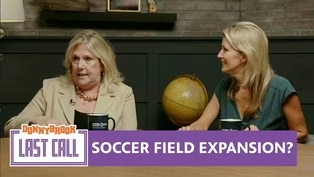
NewDonnybrook Last Call | July 23, 2026
Video has Closed Captions
Clip: S2026 Ep30 | 11m 18s | The panelists discuss a few additional topics that weren’t included in the show. (11m 18s)
Providing Support for PBS.org
Learn Moreabout PBS online sponsorship New Episode
- News and Public Affairs

Top journalists deliver compelling original analysis of the hour's headlines.

- News and Public Affairs

Today's top journalists discuss Washington's current political events and public affairs.




 New Episode

 New Episode

 New Episode
Support for PBS provided by:
Donnybrook is a local public television program presented by Nine PBS
Support for Donnybrook is provided by the Betsy & Thomas O. Patterson Foundation and Design Aire Heating and Cooling.