
May 27, 2026 - PBS News Hour full episode
5/27/2026 | 57m 46sVideo has Closed Captions
May 27, 2026 - PBS News Hour full episode
May 27, 2026 - PBS News Hour full episode
Problems playing video? | Closed Captioning Feedback
Problems playing video? | Closed Captioning Feedback
Major corporate funding for the PBS News Hour is provided by BDO, BNSF, Consumer Cellular, American Cruise Lines, and Raymond James. Funding for the PBS NewsHour Weekend is provided by...
May 27, 2026 - PBS News Hour full episode
5/27/2026 | 57m 46sVideo has Closed Captions
May 27, 2026 - PBS News Hour full episode
Problems playing video? | Closed Captioning Feedback
Where to Watch PBS News Hour
PBS News Hour is available to stream on pbs.org and the PBS app.
Providing Support for PBS.org
Learn Moreabout PBS online sponsorshipGEOFF BENNETT: Good evening.
I'm Geoff Bennett.
AMNA NAWAZ: And I'm Amna Nawaz.
On the "NewsHour" tonight: Texas Attorney General Ken Paxton defeats incumbent Senator John Cornyn in a Republican primary run-off election and the latest show of President Trump's grip on the GOP.
GEOFF BENNETT: We speak with Cuba's deputy foreign minister amid escalating threats from the White House, including an arrest warrant for the country's former leader.
JOSEFINA VIDAL FERREIRO, Cuban Deputy Foreign Affairs Minister: We have reasons to have doubts about the seriousness of the United States' side.
In the midst of our conversations, the United States has continued to take measures that affect Cuba and the Cuban people.
AMNA NAWAZ: And the search for antibiotics undergoes a dramatic transformation with the deployment of artificial intelligence.
(BREAK) AMNA NAWAZ: Welcome to the "News Hour."
President Trump proved his political power in Texas last night, as his endorsed candidate in the state's U.S.
primary run-off won in a landslide.
GEOFF BENNETT: Attorney General Ken Paxton secured the Republican nomination in Texas, beating incumbent Senator John Cornyn by nearly 30 points.
KEN PAXTON (R), Texas Senatorial Candidate: President Trump is the leader of our party, and his endorsement is the most powerful force in politics.
(CHEERING) KEN PAXTON: And I'm honored to have his support and I look forward to working with him in the Senate to deliver for Texas.
GEOFF BENNETT: Cornyn, who has represented Texas in the Senate for more than 20 years, said he would support Paxton in the general election.
SEN.
JOHN CORNYN (R-TX): There's a simple rule in elections.
You have heard me say it before.
And that is the candidate who gets the most votes wins.
The party in the majority gets to govern.
And my hope is to keep my party in power for generations.
GEOFF BENNETT: Paxton will face Democratic nominee James Talarico in the fall in what's set to be one of the nation's marquee midterm races.
For analysis of last night's results in Texas, we're joined now by Brandon Rottinghaus.
He's a professor of political science at the University of Houston and co-host of Houston Public Media's "Party Politics."
It's great to have you here.
Thanks for being with us.
BRANDON ROTTINGHAUS, University of Houston: Yes, my pleasure.
GEOFF BENNETT: So I saw you described John Cornyn's loss last night as the end of Bush era Republican model politics in Texas.
Is this primarily about Donald Trump or is there a deeper realignment of what's happening inside the GOP?
BRANDON ROTTINGHAUS: It's a good question.
I think it's a little bit of both.
Obviously, John Cornyn symbolized the traditional Texas GOP that came to power in the 1990s.
They were able to convince voters that small government with low taxation was the way to go.
That changed Texas and, frankly, changed the country.
The emergence of Donald Trump definitely exacerbated some of what was already happening in Texas, which was that it was a very conservative place and the model in Texas is adapt or die.
And essentially Republicans are following that mantra, attempting to find the more conservative wing of the party, embrace them and ride that to victory.
GEOFF BENNETT: Ken Paxton, as you well know, he has survived impeachment, indictment, FBI scrutiny, repeated ethical controversies and yet he has emerged politically stronger.
What does that say about how Republicans view character and define electability?
BRANDON ROTTINGHAUS: I think this is really kind of a front of the times, where you're seeing scandals not matter as much as they used to.
Effectively, Ken Paxton turned surviving impeachment into a loyalty test.
It was not just for this race, but also for races downballot.
His legal troubles essentially solidified his image as an outsider, instead of destroying his political career, as it might have, say, decades ago.
Donald Trump's support on this, I think, really kind of wrap them together politically because they have both been political survivors.
They have both used these scandals as a way to decide and talk about how they're the fighters that the country needs, and their partisans very much back them on it.
GEOFF BENNETT: Ken Paxton is a structurally weaker general election candidate by any conventional measure as compared to John Cornyn.
But Democrats have not won a statewide race in Texas since 1994.
So what's your honest read of what this might mean for November?
BRANDON ROTTINGHAUS: There's no question that Ken Paxton is among the weaker of the nominees and Republicans nationwide are definitely worried about having to stretch their dollars to defend Texas.
That has never been a major issue.
And the fact that it's happening definitely reflects that they're worried Ken Paxton's ethical and legal baggage is going to be a problem going into November.
For a lot of voters, the first thing they will know about Ken Paxton will be something negative, and that's not a great stepping-off point.
Ken Paxton's trying to bring Talarico's numbers down too.
We have seen that even today.
And obviously this is going to be a battle where we're going to see all the rocks getting thrown.
So the scandals are going to matter, for sure.
But for Texas voters, the question is, who can better deliver on these promises?
This is going to be an election that's really pocketbook-focused, but it's also going to be a mobilization election.
So if it's a straight-up fight between Republicans and Democrats, Republicans have the edge.
Texas is a big state.
It's an expensive state.
The structural advantage that Republicans have here is significant.
But if Talarico can find the right messaging and he can mobilize not only his voters, but also nonvoters or reluctant voters, sometimes crossover voters, then there's a chance Texas could flip.
GEOFF BENNETT: On the Democratic side we saw several Democrat-versus-Democrat run-offs in Texas this year because of redistricting, including in Houston with Congressman Christian Menefee beating longtime Congressman Al Green in their run-off and in Dallas with former Congressman Colin Allred beating Congresswoman Julie Johnson.
Several of these House run-offs have turned into proxy battles between different wings of the Democratic Party.
Are there lessons to take away from the results?
BRANDON ROTTINGHAUS: I think so.
I think you're right that redistricting has really worked as a serious disrupter in the Democratic side.
And there's no doubt that that's been complicated and controversial.
But in a way it's exposed a kind of new generation of Democrat.
This is a generational transition we're seeing in a place like Houston and in places like Dallas.
Democrats are considering what their future looks like.
And they're looking to a new generation to be able to figure that out.
Now, sometimes, that new generation has already been in power and they have been effective at it.
But that's what the voters are looking for.
It seems like they're interested in finding those fighters who can work the inside and who can use that leverage to be able to make things better.
So that type of politics really is, I think, a kind of new model for the way the center of gravity is for the Republican Democratic Party now.
GEOFF BENNETT: Brandon Rottinghaus of the University of Houston and co-host of Houston Public Media's "Party Politics," thanks again for your time.
BRANDON ROTTINGHAUS: Hey, appreciate it.
Thanks.
AMNA NAWAZ: We start the day's other headlines in Washington state, where authorities say there's no hope of finding any more survivors from yesterday's implosion at a paper mill near the Oregon border.
GOV.
BOB FERGUSON (D-WA): We're bracing ourselves for this being the deadliest industrial tragedy in modern Washington state history.
AMNA NAWAZ: Officials say two people are now confirmed dead after a tank imploded at the Nippon Dynawave Packaging facility and released a harmful chemical mixture called white liquor.
Nine others remain missing and are presumed dead.
Another eight people were injured, including a firefighter.
Officials said today that some of the contamination entered the local Columbia River, but stressed that there's no risk to the local water supply.
Peace talks between the U.S.
and Iran remain in flux, even as Iranian state TV outlined an unofficial framework agreement earlier today.
It would restore commercial shipping in the Strait of Hormuz to prewar levels, while the U.S.
would withdraw its forces and lift a naval blockade.
The White House called the report a -- quote -- "complete fabrication."
Meantime President Trump convened his Cabinet at the White House, where he said domestic political pressures like the midterms would not affect his war strategy.
DONALD TRUMP, President of the United States: Iran is very much intent, they want very much to make a deal.
So far, they haven't gotten there.
We're not satisfied with it.
But we will be.
We will be.
Either that, or we will have to just finish the job.
They're negotiating on fumes.
But we will see what happens.
Maybe we have to go back and finish it.
Maybe we don't.
AMNA NAWAZ: Separately today, Israel warned residents across Southern Lebanon to leave, signaling an expansion of its campaign against Hezbollah militants there.
It's the first such warning since an uneasy cease-fire went into effect last month.
Yesterday, several Israeli strikes came down near the Qaraoun Dam, which sits on the largest water reservoir in Lebanon.
Also today, Hamas confirmed that Israeli airstrikes killed their latest military leader in Gaza.
Mourners and Hamas supporters carried the body of Mohammed Odeh along with some of his family members through the streets of Gaza City.
It comes less than two weeks after Israel's killed Odeh's predecessor, Izz al-Din al-Haddad.
The strikes also injured at least 12 others and came on the eve of the Muslim holiday of Eid al-Adha.
It left residents sifting through rubble for their belongings or other bodies.
MOHAMED ISHTEIWI, Gaza City Resident (through translator): This is a day of Eid.
It is a holy day, and some people forgot about the war.
But after what happened, people were shocked completely.
They couldn't take it anymore.
AMNA NAWAZ: The attacks targeting Odeh last night came despite a cease-fire between Israel and Hamas that's been in effect since October.
Gaza health authorities say such strikes have killed nearly 900 Palestinians since the truce took effect.
Uganda is closing its border with the Democratic Republic of Congo -- quote -- "with immediate effect," as authorities try to slow the spread of Ebola.
There are now nearly 1,000 suspected cases in the DRC and at least 220 suspected deaths.
In the meantime, the World Health Organization has started construction on a treatment facility in the east of the country.
And the Trump administration is reportedly planning to send Americans exposed to Ebola to a new facility in Kenya, instead of flying them back to the U.S., though that site has not yet been built.
In Laos, five people who were trapped in a flooded cave for more than a week have been found alive.
Rescuers celebrated outside the cave when contact was made with the missing villagers.
Inside, video showed the men, lit by flashlights, huddled together smiling and safe.
They entered the cave on May 19, with some reports saying they were searching for gold.
Heavy rains triggered flash flooding that blocked their exit.
Lao and Thai rescuers are continuing to search for two others who remain missing.
On the South Lawn of the White House, construction is under way for an octagon-shaped cage to host next month's UFC bout.
A giant arch is already looming over the historic mansion.
The mixed martial arts event is part of celebrations to mark 250 years of American independence and is scheduled for June 14, both Flag Day and President Trump's birthday.
He's been a longtime supporter of the UFC, or Ultimate Fighting Championship, and was the first sitting president to attend a fight.
When finished, the temporary arena is expected to hold 5,000 people, as seen in this rendering.
On Wall Street today, all three major indices closed at all-time highs as oil prices eased.
The Dow Jones industrial average added nearly 200 points on the day.
The Nasdaq rose just 18 points, so a small gain there.
The S&P 500 added just one point, but technically enough for a new record.
And Ferrari is now taking orders for its new first-ever electric vehicle.
But if critics and financial markets are any indication, interest in the new car may be low.
The launch of the Luce, meaning Light in Italian, landed with a thud among Ferrari fans, who bristled at its bubble-like exterior.
A former company chairman warned of -- quote -- "the destruction of a legend," and the company stock initially fell in Milan and on Wall Street.
But Pope Leo seemed impressed when he was given a firsthand look outside his summer residence yesterday.
The Luce comes with 1,000 horsepower, a 10-inch touch screen, and an estimated price tag of more than $600,000.
Still to come on the "News Hour": outgoing World Food Program Director Cindy McCain reflects on how changes to U.S.
foreign aid impact the agency's work; we speak to actors Laurie Metcalf and Nathan Lane the classic "Death of a Salesman" returns to Broadway; and a new museum chronicles the life and advocacy of Civil War abolitionist Thaddeus Stevens.
Cuba received a tranche of humanitarian aid from China this week, as people there experienced severe hunger due to food shortages and economic crisis, this as the Trump administration maintains that the island poses a threat to the U.S., but says dialogue remains open.
MARCO RUBIO, U.S.
Secretary of State: So, we will be talking to them.
We will be working on it.
We want something good for the Cuban people.
Having a failed state 90 miles from our shores is a threat to the national security of the United States.
AMNA NAWAZ: Earlier today, I spoke with Cuba's deputy foreign minister.
And in this exclusive interview, we discussed the dire situation there and what she says is Cuba's right to defend itself.
Deputy Foreign Minister Josefina Vidal Ferreiro, welcome to the "News Hour."
Thank you so much for joining us.
JOSEFINA VIDAL FERREIRO, Cuban Deputy Foreign Affairs Minister: It's my pleasure to be with you today.
AMNA NAWAZ: You have said several times dialogue is key here.
Dialogue is what can bring our countries, the U.S.
and Cuba, together.
Can you tell us, is there any dialogue going on right now between U.S.
and Cuban officials?
When's the last time the two sides spoke?
JOSEFINA VIDAL FERREIRO: The channel for dialogue is open.
We have always favored dialogue with the United States and with any other country, because we see it as the only way for countries to discuss their differences and to look for a way to make progress in the bilateral relationship.
And we have reasons to have doubts about the seriousness of the United States' side, considering that, in the midst of our conversations, our contacts, the United States has continued to take measures, measures that affect Cuba and the Cuban people in a big way.
AMNA NAWAZ: I want to ask you more about that impact in a moment, but when you say the channel is open, does that mean that you are currently involved in negotiations with the U.S.
government?
And are you yourself involved?
JOSEFINA VIDAL FERREIRO: We have always handled these conversations historically, normally, in a discreet way, because we feel that it is important to create conditions for both countries to discuss openly.
But I can reiterate that the channel is open.
AMNA NAWAZ: In the meantime, we have seen the U.S.
government continue to ratchet up economic pressure.
We should note that Cubans are no strangers to power outages before the blockade, but now we're seeing reports of hourslong power outages most of the day, massive food shortages.
Can you help us understand here, how dire is the situation on the ground in Cuba right now?
JOSEFINA VIDAL FERREIRO: Imagine a country not receiving in five months one drop of oil.
We have had to postpone, for example, surgeries.
That has had an impact, the oil blockade on electricity generation.
And, as a consequence, that has an impact on health services, on education, on water supply.
The whole Cuban population is under a lot of pressure.
And there is no justification for this collective punishment.
AMNA NAWAZ: Well, let me just put to you the argument we have heard from the Trump administration, which, as I'm sure you have seen in reports, the U.S.
has now said that Cuba poses a national security threat to the United States.
They claim Cuba is acting as a sanctuary for U.S.
adversaries just 90 miles away from the U.S.
border.
What do you say to all those allegations?
JOSEFINA VIDAL FERREIRO: The United States government is not telling the truth.
So the United States agencies know very well that Cuba is not and has never been a threat to the United States.
On the contrary, we consider that the United States has always been an existential threat for Cuba.
So this is not the truth.
Cuba is not a threat to the United States, has never been a threat to the United States.
There are no foreign military bases.
The only foreign military bases which still exist in Cuba is the U.S.
Naval Guantanamo base, against the will of the Cuban government and the Cuban people.
AMNA NAWAZ: If I may just clarify, Madam Minister, the U.S.
isn't alleging there are military bases.
They're saying they're intelligence operations, essentially listening posts, personnel from China and Russia who are positioned there to use Cuba as a base to listen from.
Are you saying that's not true?
JOSEFINA VIDAL FERREIRO: No operations by anybody who might be a threat to the United States from the territory of Cuba.
This is the case now.
This has always been the case.
AMNA NAWAZ: Did the CIA director, John Ratcliffe, when he visited Havana recently, did he present any evidence to support these allegations?
JOSEFINA VIDAL FERREIRO: I am not going to speak about such a visit.
AMNA NAWAZ: Can you say if the U.S.
has tried to present any evidence to Cuban officials to back up these claims?
JOSEFINA VIDAL FERREIRO: The United States has never presented any evidence officially to Cuba that might demonstrate or show that Cuba might be a threat to the United States.
This is a construction.
This is a pretext that is being used in order to justify the escalation that doesn't have any justification at all in order to continue punishing the Cuban people and Cuba.
AMNA NAWAZ: You have heard President Trump has repeatedly said he can do anything he wants in Cuba, that he can take Cuba in some form.
You have seen an increase in U.S.
surveillance flights around Cuba.
We have -- U.S.
has positioned an aircraft carrier nearby in the Caribbean.
What are you preparing for?
What kind of action are you anticipating if there will be some U.S.
military action?
JOSEFINA VIDAL FERREIRO: We are taking very, very seriously threats coming from the United States.
And we have always been ready to defend our country, unfortunately so.
When you see -- when you look at the history between Cuba and the United States, confrontation, hostility has been a permanent characteristic of this relationship.
Self-defense has always been a priority, considering a confrontation that has prevailed in our relationship.
It would be naive for us not to be ready in order to defend ourselves in case there is an aggression from the United States to Cuba.
AMNA NAWAZ: And what does that defense potentially look like?
JOSEFINA VIDAL FERREIRO: Well, we don't seek conflict with the United States.
We hope it is prevented, because we don't see any reason why Cubans and Americans should die, because there would be thousands of deaths if there is an aggression and there will be a lot of destruction.
AMNA NAWAZ: When you say Americans shouldn't die as well, what is it that Cuba is prepared to do?
I mean, President Diaz-Canel has said that Cuba will respond if there is U.S.
military action.
He said: "We will defend ourselves.
If we need to die.
Will die."
Is Cuba prepared to strike U.S.
targets if there is U.S.
military action?
JOSEFINA VIDAL FERREIRO: Cuba will defend itself.
The American people, who are about to celebrate in a little bit more than a month 250th anniversary of its independence, will perfectly understand why Cubans are determined to defend our independence and not to have any foreign power to tell us what to do and how to do it, the same feeling you have for your independence that Cubans have for our independence.
And we are determined to defend it.
AMNA NAWAZ: May I ask you about the role of the U.S.
secretary of state, Marco Rubio, who we know has been leading many of the U.S.
efforts in the dialogue and elsewhere?
As you know, he is the son of Cubans, parents who left Cuba before Fidel Castro took power.
He's also long called for regime change.
What role do you think Secretary Rubio is playing in the economic and pressure campaign from the U.S.
right now?
JOSEFINA VIDAL FERREIRO: What I can say is that Secretary of State Marco Rubio does not know Cuba.
He has never been to Cuba.
He doesn't understand Cuba.
It seems that he is not familiar with Cuba's history.
So the message that he sends, which is a very clear message of the United States wanting to dictate on Cubans what kind of political system or model or order we should have, it reflects very clearly that he doesn't know us and he doesn't understand our history and how proud we are of our independence and our determination to defend it.
AMNA NAWAZ: President Trump has said he's dealing with people inside Cuba and there's been conversations about the potential for regime change.
So what do you say to those reports and to this idea that, in a dialogue, a leadership change could help to bring relief for the Cuban people?
JOSEFINA VIDAL FERREIRO: We are ready to discuss about everything, with one exception, which is issues related to our domestic affairs, internal order.
It's up to the Cuban people, and only to the Cuban people, to decide what we do and what decisions we make regarding our internal and constitutional order.
It's not a matter for another foreign power to decide for us how we should organize ourselves.
So this is the main message.
Apart from that, we are ready to discuss with the United States about every other issue in order to look for ways in which we can coexist and we can cooperate.
AMNA NAWAZ: Madam Minister, in Cuba, though, in a one-party system, where there's no other political parties, political pluralism is outlawed, there's no independent media, how can you be sure that this is what the Cuban people actually want?
JOSEFINA VIDAL FERREIRO: To win just a referendum just a few years ago, all the Cuban population older than 18 years old was free to decide the kind of order.
We had a referendum for the new Constitution, and the majority of the Cuban people supported that.
So this is the fact.
AMNA NAWAZ: Look ahead for me for the next two days or so, Madam Minister.
Where do you expect things to be over the next 24 to 48 hours when it comes to U.S.
relations?
JOSEFINA VIDAL FERREIRO: I think this is a question that has to be asked to the United States government.
I don't want to speculate at all.
As I said, Cuba is a peaceful country.
Cuba is a country of solidarity.
Cuba is a good neighbor, has always been a good neighbor.
Regarding what kind of policy or attitude, position the United States would adopt towards Cuba, it's a question that has to be asked to the United States government.
AMNA NAWAZ: Well, we thank you so much for making the time to speak with us today, Madam Minister.
That's the deputy foreign minister of Cuba, Josefina Vidal.
Thank you for your time.
JOSEFINA VIDAL FERREIRO: It was good to talk to you.
Thank you.
GEOFF BENNETT: This week, the head of the world's largest humanitarian organization is stepping down.
Cindy McCain has led the World Food Program for three tumultuous years through unprecedented humanitarian crises and global funding cuts.
Nick Schifrin speaks with McCain now about her legacy and the future of humanitarian assistance at a moment when international aid covers less than half of what the world needs.
NICK SCHIFRIN: Across the globe, the World Food Program says that more than 315 million people face acute hunger.
And for the last three years, executive director Cindy McCain has confronted multiple crises, two simultaneous declared famines, unprecedented attacks on humanitarian workers from Gaza to Ukraine, and widespread funding cuts, including by the United States government.
Her final day is Sunday.
And she joins me now.
Cindy McCain, thanks very much.
Welcome back to the "News Hour."
CINDY MCCAIN, Executive Director, World Food Program: Thank you.
NICK SCHIFRIN: It's always a pleasure.
Let me just start with that big number that I just mentioned, 315 million.
That's more than double the number that it was in 2019.
How have so many become so hungry?
CINDY MCCAIN: I think it's a combination of things.
There's so many new conflicts that have erupted around the globe.
We have had climate change issues, as you know.
We have had major environmental impacts with hurricanes and with typhoons around the globe.
It's really the perfect storm for food insecurity.
NICK SCHIFRIN: As I just laid out, you have had a tumultuous run as executive director, if it's OK for me to explain that, two simultaneous famines in Gaza and Sudan declared.
We have never seen that in the past.
We have had these attacks on humanitarian workers and, crucially, funding cuts, especially by the U.S.
And you and the WFP have said that that could cause an additional 58 million people to face starvation.
Do you leave this role with fear for those trends or faith that they can be combated?
CINDY MCCAIN: I think a little bit of both, quite frankly.
We have increased in famine and food insecurity around the globe.
But I know what our teams are capable of, and I know what this organization is capable of.
So the hope that I have is that these people are in place.
They do their jobs impeccably.
They're also people that never tire.
They will risk their lives to feed.
And so that's my hope, in knowing that all these people will be able to help those who can help themselves.
But funding is a large part of that.
And without the funding and without the political will of the world, we won't be able to do that.
But let me also say -- you mentioned Ukraine.
Humanitarian aid workers are not targets.
And we have been hit twice in the last two weeks.
And UNHCR was hit, and another convoy OCHA was in was hit.
They're targeting us directly, and that's unacceptable.
NICK SCHIFRIN: What does that say that humanitarian workers are being targeted in Ukraine?
And we also saw hundreds, according to the U.N., die in Gaza.
CINDY MCCAIN: It's a lack of respect for humanitarian law.
It's the inability for us to really get the message out also and making sure that countries and regions understand what's at stake.
If we can't feed people, the worst of the worst is going to happen.
They're going to migrate.
Women and children are going to be hit hardest in all this.
The bad guys will intermingle in all this and really, really cause chaos.
Food security is national security.
NICK SCHIFRIN: Let me zoom in into a couple of the crises that you're facing.
The most recent, of course, is the war in Iran and the closure of the Strait of Hormuz.
WFP has estimated that some 45 additional million people could be at risk of acute hunger.
What happens if the strait is not open, and where is the impact felt the most?
CINDY MCCAIN: Our costs are 20 percent higher.
So that's 20 percent less money that we can use to feed people because we have to buy expensive gas, expensive fertilizer.
We can't move it as efficiently as we should be able to because access is denied.
We need the strait to open.
NICK SCHIFRIN: One of the countries that you have been focused on so much in the last few years is the largest humanitarian crisis in the world, Sudan.
And that is also one of the most vulnerable to the closure of the strait.
NICK SCHIFRIN: Some 40 percent of the population there right now are facing crisis levels of hunger.
As you said, higher prices for food and fuel means less food.
What will happen to Sudan if the strait isn't open?
CINDY MCCAIN: You know, in the worst-case scenario, the country could implode, I mean, and just turn into complete anarchy.
To be able to keep people safe and to be able to feed people as well, not just with food, but safety, we need to be able to help stabilize the country.
And food is the largest factor in that.
NICK SCHIFRIN: Take a minute to dwell on that idea of all of the families, all of the people who are hungry who you have met over the years.
Is there one story, is there one moment in the last few years that will stay with you and that you think symbolizes the needs, the crisis that the world faces right now?
CINDY MCCAIN: I was in Sudan, actually, and we were in a kind of a camp, that makeshift camp, that had been set up.
People were just kind of lodging there until they could move on.
But it was a mother and a child.
They took me into it, to her dwelling, which is a partial tent.
And this woman, with all the hardships she'd had, she'd walked great distance, and she had her child and another child with her, who was not hers, but that she'd picked up on the road because his mother had died.
And she said -- she said, with great dignity, said: "We just need food."
And she was so direct.
She didn't want anything else from me.
And she really said: "Take the message back, please.
And please don't forget us."
I think that was one of the most, for me -- I stepped up and got out of the tent once I was finished and it moved me to tears, to be honest with you.
NICK SCHIFRIN: Unfortunately, your ability to help that mother and so many people around the world has been affected by funding cuts.
This is not exclusively a Trump administration issue or a U.S.
issue.
This happened before the Trump administration.
But can you talk about the legacy at this point of the depth of the cuts to USAID and all of the humanitarian organizations that the U.S.
has cut off funding from and also the way, the accelerated way that those cuts were made?
CINDY MCCAIN: Well, it's tragic, I mean, in terms of our ability to be able to operate.
And it is not just the United States.
It is worldwide.
Most every country's either cut or had to cut funding to our organization and other organizations like us.
So we continue to make our case, to describe just exactly what we're seeing on the ground, and why food security is so important.
This isn't all about defense, although defense is a large part of it, but food security is part of that package.
It has to be, because food is the way to stabilize regions and countries.
And we can't -- but we can't do it without everybody's willingness to participate in this and make sure that we can make it happen.
We're losing generations of children right now.
And that's not fair.
NICK SCHIFRIN: Cindy McCain is the outgoing executive director of the World Food Program.
Cindy McCain, thank you very much.
CINDY MCCAIN: Thank you.
AMNA NAWAZ: Drug-resistant infections are a major public health threat around the world, responsible for more than a million deaths each year.
So scientists are constantly trying to find and develop new antibiotics.
Miles O'Brien reports on how researchers now say A.I.
is helping to speed up their search.
MILES O'BRIEN: This is the front line in a biological arms race to salvage the crumbling foundation of modern medicine, antibiotics.
They make surgery routine, protect cancer patients, and turn once deadly infections into minor inconveniences.
MAN: Let's take a look at gonorrhea first.
MILES O'BRIEN: The discovery of penicillin changed everything, not least the treatment of sexually transmitted disease.
MAN: It is a great boon to the private physician, the clinic, and, of course, to the patient.
MILES O'BRIEN: But success comes with a fatal paradox.
DR.
MELIS ANAHTAR, Massachusetts General Hospital: The more we deploy this lifesaving medicine, the less effective they are in the long term.
MILES O'BRIEN: Melis Anahtar is a clinical microbiologist at Massachusetts General Hospital.
DR.
MELIS ANAHTAR: It's unlike any other drug where, when we use antibiotics, we, by definition, lose them because we're in this constant race with bacteria, where the bacteria can evolve resistance to our antibiotics in real time.
MILES O'BRIEN: Bacteria develop resistance to antibiotics through a simple process of evolution.
In any infection, there are millions of bacteria, and some have mutations that help them survive a drug.
When antibiotics are used, they kill the vulnerable bacteria, but the resistant ones survive, multiply, and spread.
Over time, these resistant strains become dominant, making the drugs less effective or even useless.
There's kind of this never-ending war.
DR.
MELIS ANAHTAR: Absolutely.
MILES O'BRIEN: These microorganisms are -- they're just not going to quit.
DR.
MELIS ANAHTAR: They do not quit.
MILES O'BRIEN: But neither does she or her colleagues here at the Broad Institute of MIT and Harvard.
Historically, to find and test new antibiotics, researchers would gather up some molecules stored in a deep frozen library of compounds and then apply them one by one to a pathogen to see what can either stunt its growth or kill it outright.
Biomedical engineer Jim Collins runs the lab.
JIM COLLINS, Massachusetts Institute of Technology: It's a laborious process.
It's very much kind of searching for a needle in a haystack that's an expensive haystack.
MILES O'BRIEN: They would find a promising molecule less than 1 percent of the time.
Enter artificial intelligence.
Collins and his team trained a deep neural network to analyze the chemical structures of molecules.
JIM COLLINS: And bond by bond, substructure by substructure, so kind of these ball sticks that we all remember from our high school chemistry days, could associate those properties with being antibacterial or not antibacterial.
And now a model was trained that you could feed a new compound structure, these balls and sticks, and the model could calculate, could this make for a good antibiotic?
MILES O'BRIEN: They applied the A.I.
to the library of 6,000 compounds here at Broad to find molecules that would make for antibiotics that are effective, are not toxic to human cells, and have not yet been discovered.
JIM COLLINS: Of the 6,000, only one molecule satisfied all three criteria, and it's a molecule we call halicin.
And halicin turns out to be a remarkably potent new antibiotic that kills multidrug-resistant, extensively drug-resistant and pan-resistant bacteria through a new mechanism of action.
MILES O'BRIEN: Then they deployed A.I.
and computing power to virtually generate and screen 70 billion theoretical molecules to test how they might behave.
In this case, A.I.
is doing something computational chemist Andreas Luttens does intuitively, instantly seeing what molecules might work against a pathogen based on how the balls and sticks line up.
ANDREAS LUTTENS, Computational Chemist: I usually work with a bucket system and -- or a scoring system.
Like, there's stuff that I really like, stuff that I hate.
No, no, no, no, no, maybe, no.
MILES O'BRIEN: This is like small molecule Tinder.
You kind of swipe right, right?
ANDREAS LUTTENS: Yes.
Yes, exactly, yes.
MILES O'BRIEN: Yes.
ANDREAS LUTTENS: It is a molecular dating app.
You're trying to find compounds that you like, and you can go quite fast in the selection procedure.
MILES O'BRIEN: He may be fast, but he can't match the scale and persistence of a machine.
ANDREAS LUTTENS: Depending on how much coffee I get, how long I can stay awake, but it will beat me eventually.
MILES O'BRIEN: Which brings us back to Melis Anahtar and the pathogen she is focused on, Neisseria gonorrhoeae.
That's gonorrhoeae right there, huh?
DR.
MELIS ANAHTAR: This is gonorrhoeae.
MILES O'BRIEN: Wow.
Looks nasty.
DR.
MELIS ANAHTAR: So you see these little colonies, grayish.
MILES O'BRIEN: Yes.
Untreated, the sexually transmitted disease can escalate into serious, sometimes irreversible health problems.
The bacterium is resistant to nearly everything, outsmarting new drugs about every five years or so.
The currently prescribed antibiotic Ceftriaxone is nearing the end of its efficacy.
Finding something new and potent is an urgent problem.
The A.I.
system screened 45 million chemical fragments from that vast universe.
The most promising chemical seed was used to generate an additional seven million candidates.
After rigorous filtering, two of these new compounds were synthesized and tested against real bacteria in the lab.
DR.
MELIS ANAHTAR: Is it really killing the bug in vitro?
And is it not harming human cells?
Pink means there's bacterial growth, and blue means that the growth is inhibited.
So we want to see lots of blue.
MILES O'BRIEN: This looks like a home run here.
DR.
MELIS ANAHTAR: So this one looks good.
This one was not as successful.
MILES O'BRIEN: Oh, not so good, yes.
In the end, there was one novel compound that killed drug-resistant gonorrhea without causing serious harm to human cells.
DR.
MELIS ANAHTAR: Not only can we find these antibacterial compounds, but they're actually inhibiting new targets.
This was created from scratch based on what it learned from existing small molecules and drugs.
MILES O'BRIEN: Globally, drug-resistant infections kill more than one million people each year.
And if nothing changes, the experts predict that number will increase by 50 percent by 2050.
So is resistance right now moving faster than the research to try to address it?
JIM COLLINS: Resistance had been developing faster than the research and development that had been under way.
But I believe that this infusion of A.I.
has now changed the game.
We now have tools that have dramatically expanded our ability to both discover and design new antibiotics.
MILES O'BRIEN: None of this will increase the speed of clinical trials in human beings, nor should it.
And it does nothing to incentivize big pharma to manufacture new antibiotics, which don't generate big profits.
But artificial intelligence might be one way to begin recharging a crucial pipeline that has dried up.
For the "PBS News Hour," I'm Miles O'Brien in Cambridge, Massachusetts.
GEOFF BENNETT: "Death of a Salesman" tells the story of Willy Loman, a traveling salesman chasing the American dream, but never quite able to reach it.
Now the classic is back on Broadway in a new production that underscores the play's enduring relevance.
And audiences and critics alike are responding.
The revival has become both a box office and critical success, earning nine Tony Award nominations, more than any other play this season.
Senior arts correspondent Jeffrey Brown joined two of today's leading actors, Nathan Lane and Laurie Metcalf, at the Winter Garden Theatre for our arts and culture series, Canvas.
LAURIE METCALF, Actress: Willy, what has he got against you?
NATHAN LANE, Actor: I'm so tired.
Let's not talk anymore.
JEFFREY BROWN: It's "Death of a Salesman," at once familiar and as we have never seen it before, Willy Loman played by Nathan Lane, his wife, Linda, Laurie Metcalf, their sons Biff and happy, Christopher Abbott and Ben Ahlers.
But instead of domestic furniture, a '64 Chevy dominates the stage.
Rather than their postwar home, where the play is typically set, a timeless and placeless industrial warehouse.
LAURIE METCALF: Are we in your mind?
NATHAN LANE: We're in my mind.
We're in Willy's mind.
By taking it out of the domesticity of the house in 1949, I think it has freed the play.
It feels like Greek tragedy.
JEFFREY BROWN: It certainly is American tragedy, even the American tragedy.
NATHAN LANE: It's not what you say.
It's how you say it because personality always wins the day.
LAURIE METCALF: Oliver always thought the highest to him.
NATHAN LANE: Will you let me talk?
JEFFREY BROWN: Written by legendary playwright Arthur Miller in 1949.
NATHAN LANE: Arthur Miller tapped into something and it is always teaching us about who we are as human beings, as families, as mothers and fathers and sons and who we are as a country.
LAURIE METCALF: Two hundred dollars should carry us, but that includes the last payment on the mortgage.
JEFFREY BROWN: Remarkably, one person who's never seen it, Laurie Metcalf, purposely.
LAURIE METCALF: Whatever production I saw, then the performance of Linda Loman would be permanently -- I wouldn't be able to think of it without thinking of whoever's performance it was.
So I deliberately stayed away from all the productions of it, thinking way down the line, hey, like now, I'd be able to do the role.
So... JEFFREY BROWN: But that's thinking way back, right?
LAURIE METCALF: Yes, way back.
JEFFREY BROWN: Imagining this day might come.
LAURIE METCALF: Well... NATHAN LANE: Yes.
She has seen very few plays.
(LAUGHTER) LAURIE METCALF: Yes, over the years.
(CROSSTALK) NATHAN LANE: It kind of limits... LAURIE METCALF: I don't get out much.
So... (LAUGHTER) JEFFREY BROWN: Now 70, she's definitively made an impression on stage and screen, a charter member of Chicago's renowned Steppenwolf Theatre Company, Aunt Jackie on the hit sitcom "Roseanne."
LAURIE METCALF: I am not doing that again.
You can't make me.
JEFFREY BROWN: Oscar-nominated for her role in Greta Gerwig's film "Lady Bird."
LAURIE METCALF: No one's asking you to be perfect.
Just consider it.
JEFFREY BROWN: Back-to-back Tony Awards for 2017's "A Doll''s House Part 2" and 2018's "Three Tall Women," and now her own Linda Loman, played with an unusual strength and fierceness.
LAURIE METCALF: I don't say he's a great man.
Willy Loman never made a lot of money.
His name was never in the paper, and he isn't the finest character that ever lived.
But he's a human being, and a terrible thing is happening to him.
So attention must be paid.
We were looking for her to be a partner to Willy, looking for somebody who has boundaries, I guess, rather than zero boundaries.
Like, there are things that she will do for the family, and then things that she won't put up with anymore.
NATHAN LANE: Look at that body.
It's disgusting.
JEFFREY BROWN: Nathan Lane is also 70 and also acting royalty.
NATHAN LANE: No, don't, like, pierce the toast.
JEFFREY BROWN: On screen in such films as "The Birdcage" and stage."
He's a three-time Tony winner, including for "The Producers."
NATHAN LANE: So, in order for our scheme to work, we'd have to find a surefire flop.
JEFFREY BROWN: Like Metcalf, he dreamed of one day taking on "Salesman," but unlike her, he went out of his way to see it.
NATHAN LANE: I'm the exact opposite.
I have seen many productions.
Yes, I saw it when I was 10 years old, and was upset by it at 10.
So I had to banish the ghosts of this production.
ACTOR: He's got spirit!
JEFFREY BROWN: Renowned Willy Lomans have included Lee J. Cobb and George C. Scott, Dustin Hoffman, Brian Dennehy, and Philip Seymour Hoffman, Most recently Wendell Pierce in a production that reimagined the Loman family as Black.
NATHAN LANE: So I had to let go of all of that.
JEFFREY BROWN: But how do you do that?
(LAUGHTER) LAURIE METCALF: Shock treatment.
NATHAN LANE: How do you do that?
You take the play and you learn it and then you go moment to moment with the people you are actually going to be on stage with in a rehearsal and slowly, but surely you start to build your own Willy Loman.
JEFFREY BROWN: Pushing himself and his sons relentlessly to reach the American dream, dreaming of himself as bigger than he will ever be, Willy ends up used and discarded.
In one famous scene, he implores his young boss, Howard, to let him stop traveling.
NATHAN LANE: I'm talking about your father.
There were promises made across this desk.
You mustn't tell me.
You've got people to see.
I put 34 years into this firm, Howard, and now I can't pay my insurance.
You can't eat the orange and throw the peel away.
A man is not a piece of fruit.
He's fighting.
That's what makes him an interesting character.
He's not the most likable guy.
He's a mass of contradictions and insecurities.
But he is fighting for his life.
LAURIE METCALF: I think that's why you root for characters like that, because they just don't stop fighting.
Whether they're likable or unlikable or whatever, you have to root for the tenacity of it.
JEFFREY BROWN: And in the reimagined timeless setting by Director Joe Mantello and the creative team, all nominated for Tonys, you can't help seeing the enduring relevance of the play.
It even planted a few hints, including having Willy's boss hold a contemporary to-go coffee cup.
NATHAN LANE: You know, in 1949, Willy was seen as the victim of capitalism and the system and he just can't understand why it's not working.
I'm doing all the right things.
And just like there's a lot of men in this country who feel they were replaced or erased by... JEFFREY BROWN: Still today.
(CROSSTALK) NATHAN LANE: ... by A.I., DEI.
They're - - and they were promised something, and they're angry.
And I think Willy is -- could be counted among them.
JEFFREY BROWN: It's emotionally powerful to watch.
It must be emotionally draining to play.
LAURIE METCALF: Yes, it's very emotionally hard to get through.
You leave your emotions on the stage, but mentally it's hard to keep the ball in the air for three hours.
NATHAN LANE: Yes, it is draining.
It is -- it calls upon everything you have and it, and you can't hide in this play.
It is -- it's a play that tests you and costs you.
But every night, when you hear weeping in the dark, it's -- you feel it's all been worth it.
JEFFREY BROWN: You hear it.
You're on stage and you... NATHAN LANE: Oh, sure.
NATHAN LANE: No, you can hear people weeping.
But this is -- I'm living proof that at 70 dreams can still come true.
That's how it feels.
To do this play is a privilege.
It is the ultimate privilege of my entire career is to stand on this stage and say, you can't eat the orange and throw the peel away.
A man is not a piece of fruit.
It's why I wanted to be an actor.
LAURIE METCALF: Will you ask Howard to let you work in New York?
NATHAN LANE: First thing in the morning.
Everything will be all right.
JEFFREY BROWN: For the "PBS News Hour," I'm Jeffrey Brown on Broadway.
AMNA NAWAZ: Finally tonight, a report from PBS News Student Reporting Labs.
That's our high school journalism training program.
They bring us the story of Civil War era Congressman Thaddeus Stevens, a fierce abolitionist and advocate for racial equality.
His life and legacy are now being celebrated in a new museum.
Liz McKenna has that story.
MABEL ROSENHECK, Director of Education and Exhibition, LancasterHistory: Southerners called him the scourge of the South because not only was he advocating for the end of slavery.
He was also advocating for this total transformation of American society.
LIZ MCKENNA: Thaddeus Stevens is considered one of the most important voices for racial equality in the nation's history.
He played a pivotal role in crafting the 13th and 14th Amendments to the Constitution, the 13th abolishing slavery and the 14th enshrining birthright citizenship, due process and equal protection into the fabric of this country.
TOMMY LEE JONES, Actor: I do not hold with equality in all things, only with equality before the law.
LIZ MCKENNA: For decades, he was largely forgotten in the public imagination until his sharp tongue and iron-willed personality was brought back to life in Steven Spielberg's 2012 movie "Lincoln."
TOMMY LEE JONES: How can I hold that all men are created equal when here before me stands stinking the moral carcass of the gentleman from Ohio, proof that some men are inferior?
ROBIN SARRATT, President and CEO, LancasterHistory: He was known for having really caustic witness, and so he would just let these zingers fly both in personal interactions and even on the House floor.
One of his political peers was known to say "I'd rather tangle with a porcupine than with Thaddeus Stevens."
LIZ MCKENNA: Now, a new museum has opened at the site of his former home dedicated to Stevens and his longtime companion, Lydia Hamilton Smith.
ROBIN SARRATT: Lydia Hamilton Smith was born in 1815 in Gettysburg, Pennsylvania.
She was born in a tavern.
Her mother was Black.
Her father was a white Irishman.
And when she moved to Lancaster, it was because she wanted to take a job as Thaddeus Stevens' housekeeper.
LIZ MCKENNA: Smith broke social barriers and became an influential and wealthy property owner and businesswoman.
MABEL ROSENHECK: She accomplished a lot, both as a woman, and particularly as a Black woman.
LIZ MCKENNA: She also looked after Stevens when his health began to decline.
ROBIN SARRATT: She kept him alive for the last eight years of his life through her caretaking and her assistance.
And if not for her, we probably wouldn't have had Thaddeus Stevens live long enough to secure the passage of the 13th and 14th Amendments.
LIZ MCKENNA: More than 150 years after the 14th Amendment was ratified, the Trump administration is now attempting to overturn its guarantee of universal birthright citizenship in a case before the Supreme Court.
MABEL ROSENHECK: Fourteen Amendment really embodies a lot of these questions of, who is American, what does it mean to be American, and what are the rights that come with being American in a country where being American is an idea, not just heritage.
ROBIN SARRATT: It is the foundation for key cases that so many people will be familiar with that provided desegregated access to education and civic life, provided access to property ownership regardless of race or gender, that provided access to marriage equality, women's rights, equal rights.
It is the foundation of our modern civil rights movement.
LIZ MCKENNA: Local high school students toured the museum before its official opening and discovered how Stevens and Smith's legacies helped lay the foundation for the country.
HASSET TESFAYE-DESALGN, High School Student: Looking around at all the exhibits, I noticed how outspoken Thaddeus Stevens is and how he isn't afraid to speak his mind.
And that's something I really value and an individual, and it shows that he was actually human and he was another individual, a part of our community.
HANA REBEK, High School Student: The history of the United States is activism and speaking out.
Visitors should take that into their lives today.
And when they see things in the world that they want to change, they can look at examples like in this museum and know that they're capable of doing that too.
LIZ MCKENNA: For PBS News Student Reporting Labs, I'm Liz McKenna in Lancaster, Pennsylvania.
AMNA NAWAZ: And, remember, there's a lot more online, including a look at President Trump's latest comments to PBS News about his requirements to end the war with Iran.
That is at PBS.org/NewsHour.
GEOFF BENNETT: And that's the "News Hour" for tonight.
I'm Geoff Bennett.
AMNA NAWAZ: And I'm Amna Nawaz.
On behalf of the entire "News Hour" team, thank you for joining us.
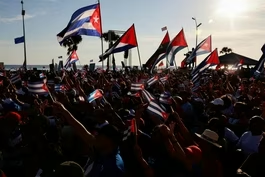
Cuban diplomat says Havana ready to defend itself from U.S.
Video has Closed Captions
Cuban diplomat says Havana not seeking conflict but ready to defend itself against U.S. (11m 11s)

How AI is helping researchers develop new antibiotics
Video has Closed Captions
How AI is helping researchers develop antibiotics to fight drug-resistant infections (7m 31s)
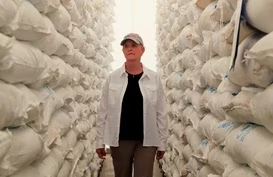
McCain says WFP faces funding pressure amid global crises
Video has Closed Captions
'Food security is national security,' McCain warns as WFP faces funding pressure (7m 50s)

Nathan Lane and Laurie Metcalf on 'Death of a Salesman'
Video has Closed Captions
Nathan Lane and Laurie Metcalf on bringing 'Death of a Salesman' back to Broadway (8m 51s)
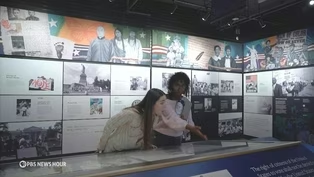
New museum spotlights Thaddeus Stevens’ abolitionist legacy
Video has Closed Captions
New museum spotlights Thaddeus Stevens’ abolitionist legacy (3m 54s)
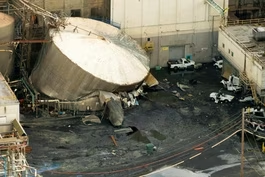
News Wrap: 11 presumed dead after Washington tank implosion
Video has Closed Captions
News Wrap: 11 presumed dead after Washington paper mill tank implosion (6m 26s)
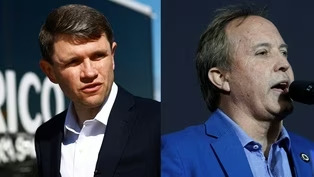
Paxton's win over Cornyn sets up high-stakes Texas clash with Talarico
Video has Closed Captions
Paxton's win over Cornyn sets up high-stakes Texas clash with Talarico (6m 24s)
Providing Support for PBS.org
Learn Moreabout PBS online sponsorship New Episode
- News and Public Affairs

Today's top journalists discuss Washington's current political events and public affairs.

- News and Public Affairs

FRONTLINE is investigative journalism that questions, explains and changes our world.

 New Episode
 New Episode

 New Episode
 New Episode
 New Episode
 New Episode
Support for PBS provided by:
Major corporate funding for the PBS News Hour is provided by BDO, BNSF, Consumer Cellular, American Cruise Lines, and Raymond James. Funding for the PBS NewsHour Weekend is provided by...